Mega-Major Preview: XOM and CVX Report Thursday — What $96 WTI Means for Permian Scale and Cash Returns
XOM | NYSE • CVX | NYSE | Source data: XOM Q4 2025 earnings release (8-K filed January 30, 2026), XOM Q1 2026 Earnings Considerations (8-K filed April 8, 2026), CVX Q1 2026 preliminary operational and financial guidance (8-K filed April 9, 2026), SEC EDGAR accessions 0000034088-26-000033, 0000034088-26-000056, 0000093410-26-000108
ExxonMobil and Chevron report Q1 2026 results Thursday, May 1. Headline earnings at both companies will look messy — large timing effects, Middle East disruptions, and working capital headwinds will compress reported EPS well below what $96 WTI should theoretically deliver. The underlying story is different: both majors are printing cash at scale, Permian production is hitting records, and the real read-through for the broader sector is what they say about Q2 Permian completion activity.
The Headline Noise: Understand It Before the Number Drops
Both companies have pre-disclosed the major drags on Q1 earnings. ExxonMobil's April 8 8-K flagged estimated timing effects of negative $0.8 to negative $0.2 billion in Upstream and negative $4.1 to negative $3.3 billion in Energy Products. Chevron's April 9 8-K disclosed total timing effects of negative $2.7 to negative $3.7 billion, predominantly in Downstream. Timing effects — the lag between mark-to-market derivative hedges and physical shipment settlement — are large and negative in rising commodity price environments. With WTI up roughly $15/bbl from Q4 2025 lows, Q1 2026 timing noise was always going to be significant. Both companies have stated these effects unwind in future periods at net profit.
CVX also flagged a $350–$400 million downstream litigation charge as a special item, Tengizchevroil downtime in Kazakhstan, and reduced production in the Middle East (Israel operations and the Partitioned Zone). ExxonMobil disclosed that Qatar and UAE assets — representing approximately 20% of 2025 annual global production — faced disruptions beginning in early March. At 4.7 million boe/d FY2025 total production, 20% is roughly 940,000 boe/d. That's the single biggest production story in XOM's Q1 guidance document and it will drive some of the volume variance versus the prior quarter's 5.0 million boe/d.
CIR Analysis: The headline EPS will understate both companies' underlying Q1 cash generation. Analysts and operators who understand timing effects know to look past the GAAP number. For anyone trying to read XOM or CVX's Q1 print as a signal about commodity market health, it isn't one — it's an accounting artifact of derivatives settlement timing in a rising-price quarter.
Permian: The Integration Read
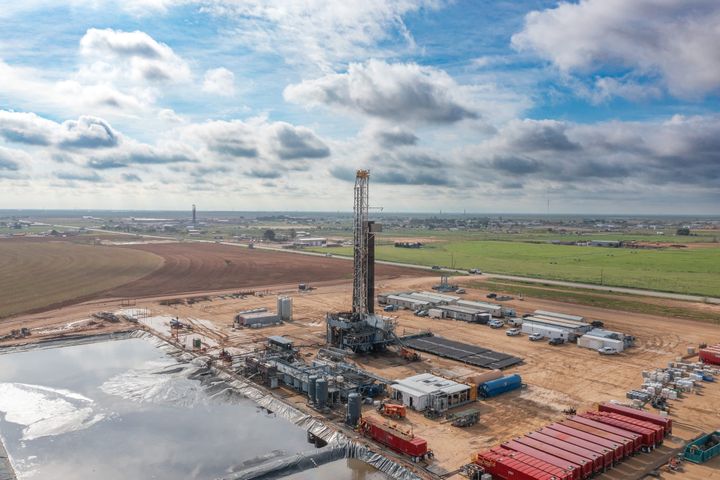
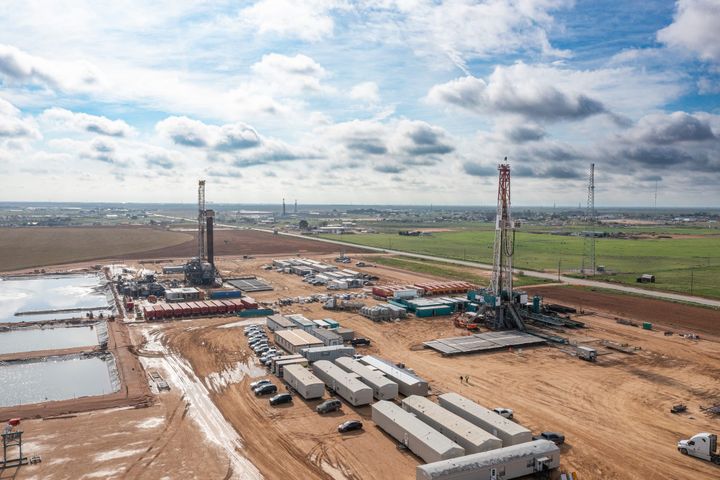
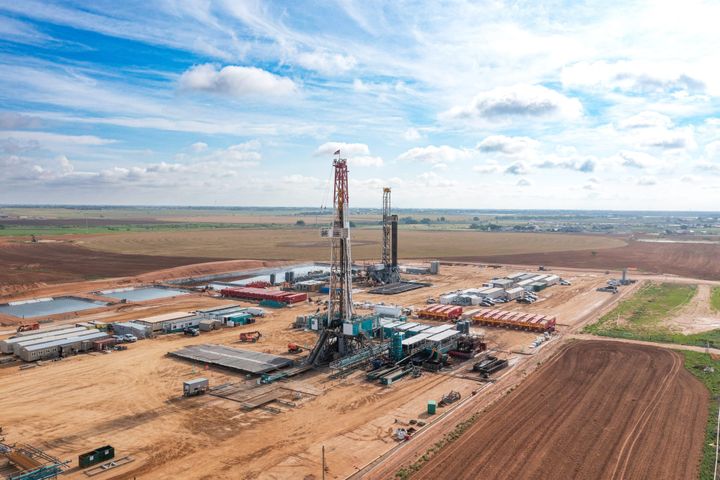
XOM's FY2025 Permian production reached 1.6 million boe/d — an annual record, and the direct output of the Pioneer Natural Resources acquisition closed in May 2024. Guyana crossed 700,000 gross barrels per day for the year. Together, Permian and Guyana represented 59% of XOM's 2025 production, up roughly 7 percentage points from 2024. That is a structural shift in asset mix: XOM is increasingly a two-asset story in upstream, with the Permian and Guyana as the growth engines.
CVX's Q1 2026 production guidance of 3.8–3.9 million boe/d reflects the Hess acquisition impact (Guyana stake now fully consolidated) alongside the Tengizchevroil and Middle East headwinds. CVX's Permian footprint — primarily DJ Basin and Permian Basin legacy acreage, supplemented by Hess assets — is smaller relative to XOM but meaningful in terms of well cost benchmarks and completion crew utilization.
For Q1, the more important number than reported production is what both companies say about 2026 Permian completion scheduling. XOM guided FY2025 cash capex at $29.0 billion (including acquisitions) and set FY2026 guidance at $27–$29 billion. That range implies no material pullback in capital deployment. At $96 WTI, staying at the high end of that guidance range is the rational choice. The question Thursday is whether Q2 Permian activity — well completions, frac stage counts, lateral lengths — comes in at, above, or below Q1 pace.
Buybacks at $100 Brent
XOM is executing a $20 billion share repurchase plan through 2026. In FY2025, the company returned $37.2 billion to shareholders — $17.2 billion in dividends and $20.0 billion in buybacks. The Q1 2026 dividend was declared at $1.03/share, up 4% year-over-year. CVX's Q1 2026 weighted average shares outstanding came in at 1.98 billion, largely flat quarter-over-quarter as repurchases were offset by employee stock option exercises — a signal that CVX's buyback pace moderated in Q1, likely due to the working capital headwinds and legal charge.
CIR Analysis: At $96 WTI and $101 Brent, both majors have the cash flow to maintain buybacks and dividends with room to spare. The more interesting Thursday read is the tone on 2026 capital priorities: does XOM management emphasize returning to shareholders versus investing through the cycle? In 2025, XOM's FCF was $26.1 billion against $37.2 billion in distributions — that gap was funded by balance sheet strength (net debt/capital 11%). Sustaining that cadence requires either maintaining commodity prices or cutting somewhere.
What To Watch: The Frac Sector Read-Through
Thursday's earnings calls matter for the services sector more than the reported EPS numbers. Three data points to track:
- Permian Q2 completion guidance. Both XOM and CVX run large Permian completion programs. Any indication of stage count increases, pad expansions, or incremental DUC drawdowns is a direct demand signal for PUMP, PTEN, LBRT, and the rest of the frac independents currently trading at cycle lows despite $96 WTI.
- Pioneer integration cost update. XOM has targeted $2 billion in synergies from the Pioneer deal through 2025. Thursday should include an update on cost per well in the Permian — if Pioneer acquisition wells are now drilling below $600/lateral-foot (XOM's legacy Permian benchmark), that's a completion demand and efficiency story worth tracking.
- CVX Hess Guyana ramp language. Guyana production has been the Atlantic Basin's growth story. Any acceleration commentary has indirect implications for US deepwater and LNG infrastructure — and directionally positive for offshore services.
Crude Intelligence Report is an independent upstream oil and gas intelligence publication. The content in this article is for informational purposes only and does not constitute investment advice, financial advice, or a recommendation to buy or sell any security. Always conduct your own due diligence before making investment decisions. CIR and its contributors may hold positions in companies mentioned; any such positions will be disclosed when known. © 2026 Crude Intelligence Report. All rights reserved.
This article contains forward-looking statements and analytical opinions. Actual results may differ materially.