ProFrac at $80 WTI: H2 Spread Count and Simulfrac Repricing Will Test a Broken Balance Sheet (ACDC)
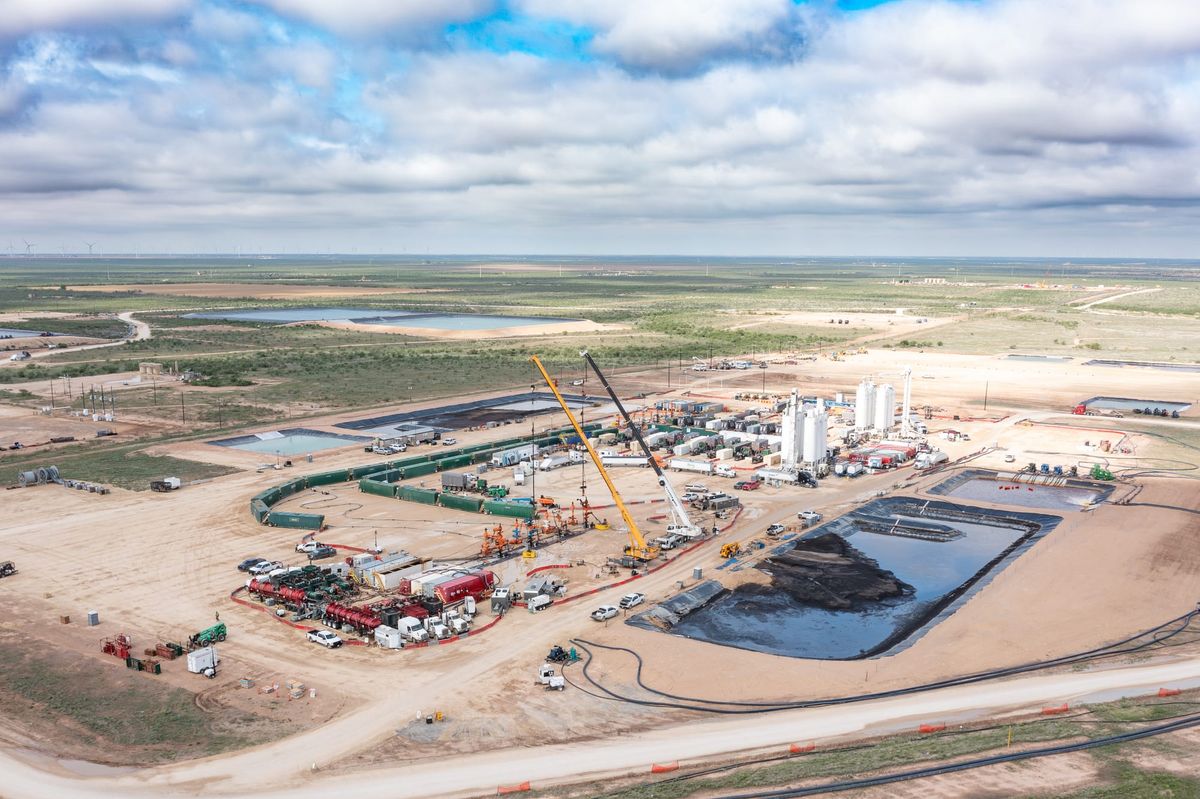
ACDC | NASDAQ | Source data: ProFrac Holding Corp. Q1 2026 10-Q (SEC accession 0001193125-26-214605, filed 2026-05-08), Yahoo Finance equity data, Yahoo Finance commodity prices
The Hormuz deal didn't rescue ProFrac's second-half outlook. WTI's crash to $80.08 this morning has reset the math on frac spread count and simulfrac pricing across the sector, and ProFrac's Q1 2026 financials confirm the company entered this price environment already under stress. Revenue fell 25% year-over-year, the operating line swung to a $46.4 million loss, and the stock is trading at $7.18 with a year-high of $10.70 and a year-low of $3.08. The question for the second half isn't whether frac pricing gets repriced. It's how far down, and who survives it.
Q1 2026: The Baseline Is Already Broken
ProFrac reported Q1 2026 total revenues of $449.6 million, down from $600.3 million in the year-prior first quarter, a 25.1% year-over-year decline. Services revenue fell to $410.3 million from $523.9 million in the prior-year period. Product sales, which includes proppant from ProFrac's vertically integrated sand mines, dropped to $39.3 million from $76.4 million in the prior year: a 48.6% collapse that reflects both lower completion activity and declining sand pricing.
Cost of revenues totaled $354.4 million, producing a gross margin of roughly 21 cents on the dollar. Total operating costs ran $496.0 million against $449.6 million in revenue, producing an operating loss of $46.4 million. In the prior-year period, ProFrac generated $16.0 million in operating income.
Interest expense of $32.8 million pushed the pre-tax loss to $79.2 million. Net loss attributable to ProFrac was $83.5 million, or $0.47 per share. Total debt stands at approximately $1.065 billion when combining long-term debt ($866.7 million), current portion ($151.2 million), and related-party debt ($46.7 million). Accumulated deficit has grown to $695.1 million.
What $80 WTI Does to Second-Half Spread Count
The Hormuz deal confirmed this morning sent WTI from a mid-$80s range down to $80.08 (Yahoo Finance, June 15, 2026). This is not a demand catalyst. It is a supply restoration event. Iranian barrels return gradually, OPEC discipline erodes, and operators who were already penciling $85 into their second-half completion budgets now face a sub-$80 reality.
CIR Analysis: At $80 WTI, the E&P calculus on incremental Permian completions shifts meaningfully. Break-even economics for most Midland Basin core acreage run $60 to $70 per barrel, so the wells still work. But the marginal completion decision, the wells that operators were on the fence about, gets pushed to 2027 or dropped entirely. That is where frac spreads get pulled. Not wholesale, but at the margins, and margins are exactly where ProFrac operates.
ProFrac's vertically integrated structure amplifies the downside. Product revenue (sand) fell 49% year-over-year in Q1. If completion activity softens further in the second half, sand volumes fall proportionally, compressing both the services line and the internal supply advantage that was supposed to buffer ProFrac against commodity swings.
Simulfrac Repricing: The Premium Is Collapsing
Simulfrac, running two frac spreads simultaneously on a single pad, carries a pricing premium because it requires coordination, equipment density, and operational sophistication. When operators were paying $85 to $90 for oil and completion activity was elevated, that premium held. The simulfrac rate premium over conventional spreading ran 10 to 15% by most market participants' estimates during the 2023 to 2024 upcycle.
CIR Analysis: That premium is being squeezed out. When E&P operators renegotiate second-half completion contracts, simulfrac gets treated as a baseline expectation rather than a premium service. The rate has been standardized, especially in the Permian where ProFrac has significant concentration. ProFrac's Q1 operating loss at full utilization suggests their current price deck is already below breakeven. A further 5 to 8% pricing haircut on simulfrac rates in second-half contract renewals would deepen losses materially.
Peer context: ProPetro (PUMP) trades at $15.05 with a year-high of $18.50 and a year-low of $4.51, implying a more favorable market read, likely because PUMP's balance sheet carries less debt and its Permian concentration includes more long-term contracted work. Liberty Energy (LBRT) at $28.10 and Halliburton (HAL) at $38.53 suggest the market is differentiating between operators with contract coverage and those exposed to spot repricing. ProFrac skews spot.
Balance Sheet Risk at $80
The stress test is not theoretical. ProFrac entered Q1 2026 with total liabilities of $1.765 billion against total stockholders' equity of $714.6 million. The debt structure includes $151.2 million in current-portion obligations due within 12 months. Cash on hand was $33.5 million at March 31, 2026.
CIR Analysis: That liquidity position, against $151 million in near-term debt service and an operating cost structure that produced a $46 million operating loss in Q1, is the real second-half risk vector. It is not just pricing. It is whether ProFrac can refinance or service its debt load through a period of falling revenue. If WTI stays at or below $80 for the remainder of the second half, ProFrac's cash flow generation math gets very tight. The company needs frac activity to hold to keep receivables converting.
What To Watch
- Second-half contract renewals: When major Permian operators release Q2 completion guidance, pricing disclosures will signal whether the simulfrac premium held or collapsed. Watch for spot vs. contracted rate commentary.
- ACDC Q2 earnings (expected August 2026): Revenue trajectory and operating margin are the critical markers. If services revenue drops below $380 million, the debt service math deteriorates toward crisis.
- Rig count and DUC drawdown: Baker Hughes North America data in late June and July will indicate whether operators are pulling second-half completion programs. A 3 to 5% dip in US land rig count is the canary.
- Sand pricing: ProFrac's proppant segment is both a revenue line and a cost input. If in-basin Permian sand prices fall further, already under pressure from Winkler and Crane County supply, the integration advantage narrows.
CIR Verdict
ProFrac was already losing money at what were supposed to be recovered oil prices. WTI at $80 does not fix that. It makes Q2 worse and turns the second-half contract season into a survival exercise. The vertically integrated model now means the company has more ways to lose money simultaneously: service revenue falls, sand revenue falls, and the debt does not restructure itself. The market is pricing ACDC at $7.18 with some recovery hope baked in. That hope depends on $82 to $85 WTI holding, and this morning's Hormuz confirmation just took the floor out from under that thesis.
Crude Intelligence Report is an independent upstream oil and gas intelligence publication. The content in this article is for informational purposes only and does not constitute investment advice, financial advice, or a recommendation to buy or sell any security. Always conduct your own due diligence before making investment decisions. CIR and its contributors may hold positions in companies mentioned; any such positions will be disclosed when known. © 2026 Crude Intelligence Report. All rights reserved.
This article contains forward-looking statements and analytical opinions. Actual results may differ materially.