Trans Mountain Full Capacity and the Ovintiv Montney Condensate Thesis (OVV)
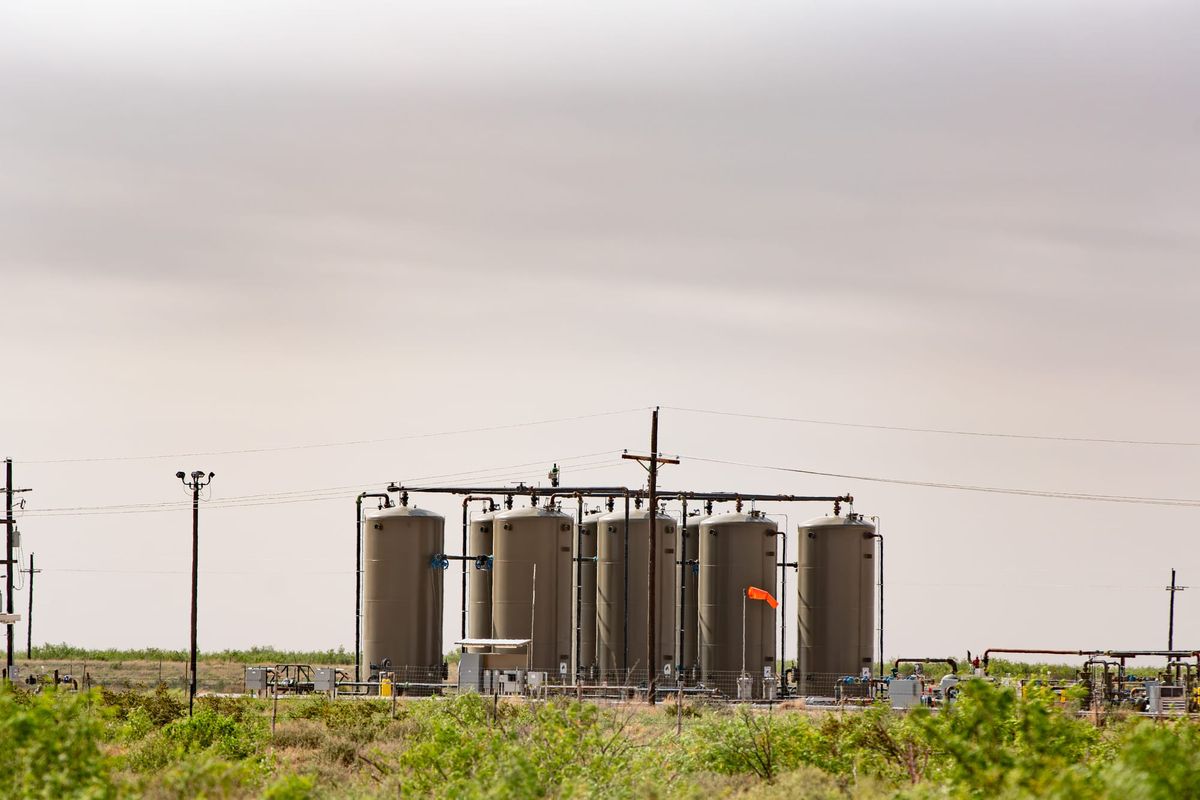
OVV | NYSE | Source data: Ovintiv Q1 2026 10-Q (SEC accession 0001193125-26-217087, filed 2026-05-11), Ovintiv Q1 2026 earnings release; commodity prices: Yahoo Finance, June 11, 2026
The Pipeline Changes the Math
Trans Mountain Expansion reached full commercial capacity in early 2026, and Ovintiv is positioned better than almost anyone to capture what that unlocks. With 890,000 bbl/d of committed capacity now flowing to Westridge Marine Terminal in Burnaby, British Columbia, Canadian heavy and condensate-rich production finally has a credible route to Pacific Basin buyers. For Ovintiv's Montney, the implications go well beyond marketing optionality. They touch well economics, condensate pricing, and the structural case for accelerating development in northeast British Columbia at exactly the moment WTI is sitting at $90.
WTI: $90.13/bbl | Brent: $92.82/bbl | Henry Hub: $3.08/MMBtu (Yahoo Finance, June 11, 2026)
Montney Is Ovintiv's NGL Story
Ovintiv's Montney position sits in the Dawson Creek and Tower areas of northeast BC. The play is liquid-rich: gas production carries meaningful condensate yields, typically in the 35 to 55 bbl/MMcf range for Ovintiv's core acreage. That condensate has historically been discounted to Edmonton Par, a Canadian crude benchmark that tracked Edmonton refiners and was largely disconnected from Pacific pricing. Trans Mountain changes that calculus.
Condensate extracted from Montney gas processing facilities is a diluent. It gets blended with bitumen and heavy oil from the oil sands for pipeline transport. With Trans Mountain moving roughly 590,000 to 640,000 bbl/d of diluted bitumen (dilbit) to Westridge, the demand for condensate diluent rises proportionally. More dilbit exports means tighter condensate supply in Alberta. CIR Analysis: tighter condensate supply in Alberta structurally supports condensate prices at Edmonton above levels that were typical when only the original 300,000 bbl/d Trans Mountain line existed.
Per Ovintiv's Q1 2026 10-Q, the company recorded $2,221 million in product and service revenues for the quarter ended March 31, 2026, up from $1,965 million in the year-earlier period. Transportation and processing expenses climbed to $471 million from $398 million, an increase of $73 million reflecting both expanded Montney processing infrastructure and higher pipeline tariff commitments. Operating cash flow was $1,056 million versus $873 million in the prior-year quarter, even as the company absorbed a $1,485 million impairment charge on its US assets tied to lower near-term WTI price assumptions.
The Impairment Tells You Which Basin They're Betting On
That impairment deserves attention. Ovintiv took $1,485 million in Q1 2026 against its US full-cost pool, compared to $730 million in the year-earlier period, using full-cost ceiling test accounting where proved properties are written down when book value exceeds the ceiling defined by trailing 12-month prices. With WTI averaging in the low-to-mid $90s over the prior year, sub-$90 price assumptions bite harder against Permian and Anadarko assets than against Montney, which benefits from gas and NGL realizations partially decoupled from WTI.
CIR Analysis: the write-down is accounting, not strategy. Ovintiv's capital allocation in Q1 tells the real story. The company spent $605 million in capital expenditures in Q1 2026, with Montney representing a growing share of activity. Management has maintained a 3-rig, 1-frac-crew cadence in the Montney through 2026, even as Permian and Anadarko activity moderated. That is a production-weighted bet on Canadian pricing, and specifically on NGL economics that Trans Mountain full capacity helps validate.
What "Full Capacity" Means for NGL Realizations
The Trans Mountain Expansion added roughly 590,000 bbl/d of incremental takeaway capacity out of Alberta. The destination market matters. Westridge Terminal can now load Aframax tankers for Asian refiners: South Korea, Japan, India, and China among them. Asian refiners pay freight-adjusted Brent-linked prices for Canadian crude, not WCS-to-Chicago pipeline prices. That closes a persistent discount gap that has penalized Alberta producers for decades.
Condensate pricing follows through a second-order effect. The Edmonton condensate market is regional and tight. Diluent is not fungible across long distances without significant infrastructure. As dilbit export volumes through Trans Mountain rise, the Alberta-area condensate market tightens. Edmonton Par condensate has been tracking in the $88 to $94/bbl range in June, closely correlated with WTI but with less of the structural discount that characterized pre-expansion pricing when diluent demand competed with refinery supply.
Ovintiv's Montney condensate volumes represent one of the company's highest-margin revenue streams. The Q1 2026 10-Q doesn't break out Montney-specific condensate volumes separately from the Canadian segment, but total-company NGL realization trajectory through Q1 showed improvement. Transportation and processing costs rose, but the rate of realization improvement outpaced cost inflation in the Canadian segment, consistent with condensate benefiting from tighter Alberta market conditions.
The Two-Basin Question at $90 WTI
Ovintiv entered 2026 running three distinct core assets: Permian (Midland and Delaware), Anadarko, and Montney. At $90 WTI, these basins do not look identical. Permian and Anadarko returns are directly indexed to WTI. Montney returns are indexed to a mix: gas to AECO (Alberta benchmark), condensate to Edmonton Par, and some export volumes accessing LNG-adjacent pricing as Trans Mountain redirects Pacific Basin supply chains.
AECO gas has been the weak link. AECO averaged approximately C$1.80 to $2.10/GJ in Q1 2026, well below Henry Hub and reflecting Alberta basin oversupply. Ovintiv hedges a portion of its AECO exposure and routes some volumes to premium markets through firm service on export pipelines. But the gas portion of Montney BOE production remains a headwind. The offsetting factor is the condensate yield. A well producing 10 MMcf/d of gas with a 45 bbl/MMcf condensate ratio is generating 450 bbl/d of condensate at roughly $90/bbl: $40,500/d in condensate revenue alone, before any gas value. That math looks better when Edmonton condensate tightens, and worse when it loosens.
CIR Analysis: Trans Mountain reaching full capacity is structurally positive for Ovintiv's Montney condensate economics, but the magnitude is modest and non-linear. The key variable is dilbit export utilization. If Trans Mountain ships 580,000 to 620,000 bbl/d of dilbit consistently through H2 2026, condensate demand stays elevated and Edmonton Par holds a tighter premium to WTI. If volumes underwhelm, the thesis softens. Ovintiv has built infrastructure to capture the upside; it does not control the utilization rate.
What To Watch
- Trans Mountain utilization data: monthly throughput reports from the Canada Energy Regulator will show whether full commercial capacity is being absorbed. Sub-70% utilization would soften the condensate demand thesis.
- Edmonton Par condensate spread to WTI: watch for the differential to hold tight (under $3/bbl discount) as a sign the diluent market is absorbing TMX volumes. A widening spread flags potential oversupply.
- Ovintiv Q2 2026 guidance: any upward revision to Montney liquids volumes or realization assumptions in the next quarterly report would validate the Trans Mountain effect on Ovintiv's specific position.
- AECO gas price recovery: if AECO recovers toward C$2.50+/GJ through LNG Canada Phase 1 ramp, the gas component of Montney BOE materially improves and the overall position strengthens considerably.
Crude Intelligence Report is an independent upstream oil and gas intelligence publication. The content in this article is for informational purposes only and does not constitute investment advice, financial advice, or a recommendation to buy or sell any security. Always conduct your own due diligence before making investment decisions. CIR and its contributors may hold positions in companies mentioned; any such positions will be disclosed when known. © 2026 Crude Intelligence Report. All rights reserved.
This article contains forward-looking statements and analytical opinions. Actual results may differ materially.