ExxonMobil at $73 WTI: The Cost Machine That Makes the Price Test Look Manageable (XOM)
XOM | NYSE | Source data: ExxonMobil Q1 2026 earnings release (8-K, May 1, 2026) and 10-Q (May 4, 2026), via SEC EDGAR
WTI is trading at $73.83 this afternoon. That's roughly $11 below where it was when ExxonMobil reported Q1 2026 results in May, and it's testing an implied floor that most operators hadn't planned for when they set H2 budgets. The market is asking whether supermajors hold their capex commitments or start trimming. XOM's Q1 data answers that question.
The Earnings Number That Matters
XOM reported Q1 2026 GAAP earnings of $4.2 billion, a number that looked weak relative to $7.7 billion in the year-ago quarter. The difference is almost entirely explained by $3.9 billion in unfavorable mark-to-market timing effects from derivative positions that had not yet settled, a timing difference that unwinds in subsequent quarters. Strip that out, and underlying earnings were $8.8 billion, up $1.2 billion from $7.6 billion in the year-ago quarter.
That improvement came despite a mixed pricing environment. The more revealing segment is US upstream. US upstream earnings fell to $1.574 billion in Q1 2026 from $1.870 billion in the year-ago quarter, a 16% drop. That's the price sensitivity. But the broader upstream segment held relatively well: worldwide upstream earnings ex-timing effects were $6.265 billion versus $6.598 billion a year ago, a decline of just 5%. Permian and Guyana volume growth absorbed most of the pricing pressure that hit the rest of the book.
CIR Analysis: The US upstream number is the honest read on what sub-$75 WTI does to ExxonMobil's domestic operations. At Q1 2026 price levels that averaged substantially higher than today's $73.83, US upstream earned $1.6 billion. At $73 for a full quarter, that number is probably 10-15% lower before offsetting volume gains. The Permian is the buffer.
The Structural Cost Machine
ExxonMobil has accumulated $15.6 billion in structural cost savings since 2019, adding $0.6 billion in Q1 2026 alone. This is the figure that gets underweighted in per-barrel price analysis. Cash operating expenses excluding energy and production taxes were $10.8 billion in Q1 2026, nearly flat with the year-ago quarter despite higher volumes. The company is expanding output while holding the cost base.
The trajectory matters for H2 planning. At a $0.6 billion quarterly pace, XOM exits 2026 at roughly $16.2 billion in cumulative structural cost savings, providing a widening buffer between realized prices and the operational break-even. Full-year capex guidance of $27-29 billion was calibrated for an $85-90 WTI environment when it was set. At $73, the math is tighter, but it is not broken.
Cash flow from operations was $8.7 billion in Q1, or $13.8 billion excluding margin postings from derivatives. Against $9.2 billion in shareholder distributions ($4.3 billion in dividends and $4.9 billion in buybacks), free cash flow was $2.7 billion. That's a quarter where distributions exceeded free cash flow, something XOM can sustain given its $8.4 billion cash position and 13.1% net-debt-to-capital ratio. It does not signal capex stress at current WTI levels.
The Permian Program Is Not Optional
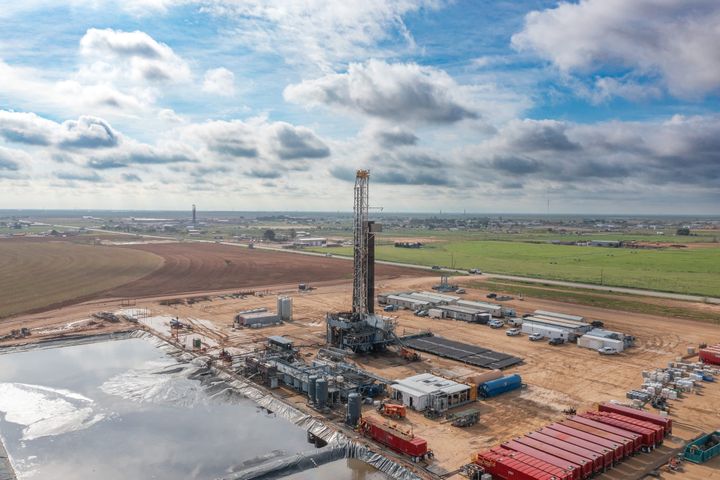
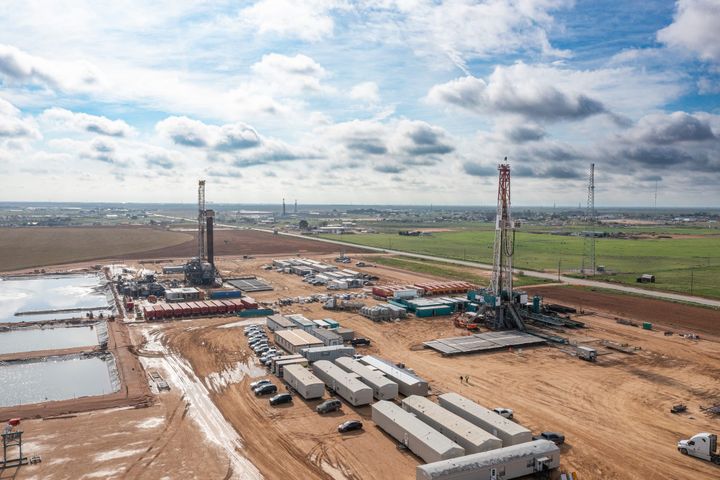
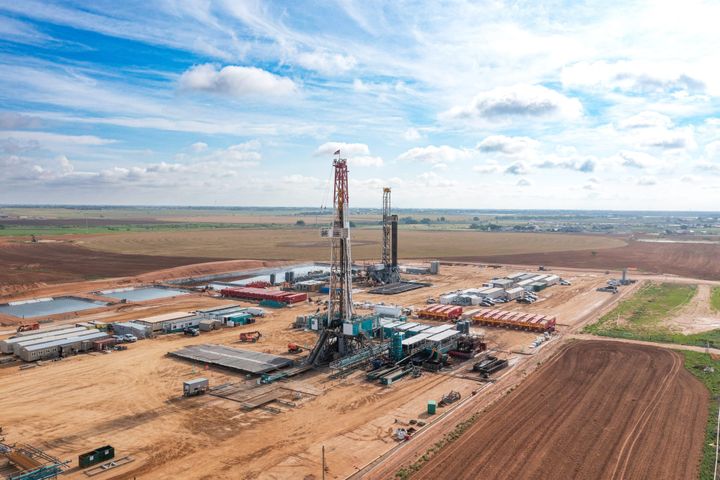
XOM's Permian is post-Pioneer: the company is now the basin's largest operator, running roughly 1.5 Mboe/d of Permian production with access to what management has characterized as 15-plus years of Tier 1 inventory from the Pioneer acquisition. US upstream capex in Q1 was $3.449 billion, on a pace of $13.8 billion annualized and the largest single capex allocation in the company's portfolio.
The Pioneer inventory thesis was built on a $60-65 WTI breakeven for Tier 1 locations. At $73, every Tier 1 well XOM drills in the Permian is generating positive economics. The question isn't whether to drill. It's whether the $27-29 billion full-year plan holds or gets adjusted at the margins. Given the Pioneer integration runway, the $15.6 billion in structural cost reduction, and the strong balance sheet, the H2 Permian program is not at risk at $73 WTI.
Where operators downstream of XOM's completion activity should pay attention: any capex trim comes from international upstream and non-Permian US operations first. XOM's Permian program runs through the cycle. That's a demand signal for Permian-facing completions service companies that holds even in a low-$70s price environment.
Golden Pass and the Long-Duration Gas Bet
XOM achieved first LNG from Golden Pass Train 1 at Sabine Pass in late March 2026, increasing US LNG export capacity by 5% relative to 2025. Golden Pass is a QatarEnergy/ExxonMobil joint venture, and Train 1's commercial ramp creates a structural demand pull for Haynesville and Gulf Coast gas supply that doesn't fluctuate with daily WTI movements.
This matters for the H2 outlook at $73 WTI: XOM's earnings power is diversifying away from crude-denominated US upstream even as that segment faces near-term price pressure. The structural cost savings, Permian volume growth, Guyana record output (over 900 thousand gross barrels per day in Q1 2026), and Golden Pass LNG ramp collectively mean XOM's earnings resilience at sub-$75 WTI is substantially better than a simple barrel-price sensitivity calculation suggests.
What To Watch
- Wednesday EIA inventory report (June 25): A second consecutive crude build above 2-3 MMbbl would test whether WTI holds $73 or dips toward $70-71. XOM's breakeven math still works at $70, but operator confidence across the basin does not.
- XOM Q2 guidance update (late July): The company will report Q2 alongside mid-year capex review. Any language about maintaining $27-29B guidance at current prices is a signal that Permian programs are protected. A reduction to the guidance range floor would indicate selective trimming of non-Permian activity.
- Golden Pass Train 2 timeline: Train 2 construction progress is the next incremental gas demand signal from XOM. Any acceleration announcement at $73 WTI would confirm the supermajor's long-duration gas conviction.
CIR Analysis: ExxonMobil's Q1 data confirms a company better positioned to absorb $73 WTI than almost any other public operator. The structural cost trajectory, Permian inventory depth, and improving LNG asset base create an earnings floor that smaller independents can't match. The risk for H2 is not XOM; it's the mid-tier operators who set H2 budgets at $80-plus WTI and now face a harder math without a $15.6 billion cost savings cushion. Those companies' decisions about frac spreads and service contracts in July and August will be more telling than anything ExxonMobil does.
Crude Intelligence Report is an independent upstream oil and gas intelligence publication. The content in this article is for informational purposes only and does not constitute investment advice, financial advice, or a recommendation to buy or sell any security. Always conduct your own due diligence before making investment decisions. CIR and its contributors may hold positions in companies mentioned; any such positions will be disclosed when known. © 2026 Crude Intelligence Report. All rights reserved.
This article contains forward-looking statements and analytical opinions. Actual results may differ materially.