EU Storage Mandates Bend, US LNG Surges: What Brussels' Retreat Means for EQT, Expand Energy, and the Drilling Contractors
Brussels is backing toward storage mandate flexibility as the EU's US LNG dependency heads toward 80%. EQT and Expand Energy are built for exactly this cycle.

EQT | NASDAQ | EXE | NASDAQ | Source data: EQT Q1 2026 earnings release (April 21, 2026), Expand Energy Q1 2026 earnings release (April 28, 2026), EIA U.S. natural gas exports by country data, IEEFA LNG market report (May 2026), IAOGP/Eurogas joint statement (May 13, 2026)
Brussels is blinking on gas storage mandates, and the direct beneficiaries sit in Appalachia and the Haynesville. Wednesday's joint petition from IAOGP and Eurogas asking the European Commission to activate flexibility on its 90% storage refill target is the regulatory confirmation of a structural shift already visible in the trade data: the EU has traded dependence on Russian pipeline gas for dependence on US LNG, and that chain is tightening.
The Mandate That Matters
The International Association of Oil and Gas Producers and Eurogas filed a joint statement Wednesday urging the European Commission to invoke flexibility provisions on the November storage fill target ahead of an informal EU energy ministers meeting in Cyprus. The context is stark: EU storage that sat at 31% earlier this spring faces a steep injection hill to reach 90% by November under current supply constraints. The Middle East disruption has taken North African and Middle Eastern LNG supply reliability off the table as a hedge, and European buyers have responded by locking in more US volumes.
IEEFA published a concurrent report — cited in wire coverage this week — projecting that the EU's reliance on US LNG will reach 80% of all EU LNG imports within two years, up from approximately 58% at the start of this year. That projection is consistent with what the EIA export data already shows. In February 2026, EU and UK destinations absorbed 354.9 Bcf out of 493.6 Bcf in total US LNG vessel exports — a 72% share. The top five EU receiving countries: UK (60.4 Bcf), Netherlands (56.8 Bcf), Germany (35.5 Bcf), France (32.7 Bcf), and Spain (29.7 Bcf). US LNG infrastructure running at 17.6 Bcf/d on a vessel basis is not a ceiling — it is a floor. Golden Pass LNG Train 1 is ramping. Additional capacity is in the pipeline. And European buyers are asking for more, not less.
The regulatory signal from Brussels is not that the EU will abandon storage targets. It is that European policymakers are openly acknowledging that LNG supply — overwhelmingly US-sourced — cannot fill the gap fast enough to hit the 90% mandate on the original timeline. That acknowledgment removes a source of demand uncertainty and replaces it with a structural offtake guarantee. US gas producers should read it as a green light, not a pause.
EQT: Built for Exactly This
EQT reported Q1 2026 results last month that read as a direct endorsement of the EU demand thesis. Sales volume came in at 618 Bcfe, above the high end of guidance, driven by strong well performance and system pressure optimization during Winter Storm Fern. Realized natural gas price: $5.07/Mcf after hedges — a 34% increase over the same quarter last year. Record quarterly free cash flow attributable to EQT: $1.832 billion. Net debt is approaching the $5.0 billion long-term target after ending Q1 at $5.7 billion. Fitch upgraded EQT to BBB during the quarter.
The Mountain Valley Pipeline mainline is now a live asset, giving EQT direct access to Southeast demand centers and improved export basis. CEO Toby Rice framed the macro setup plainly: "Accelerating power demand growth in the United States — particularly in Appalachia — is creating incremental opportunities in our backyard. Whether through our long-term LNG contracts or our ability to serve power demand domestically, EQT is uniquely positioned to benefit from these dynamics."
Q2 guidance is 570 to 620 Bcfe, which includes 10 to 15 Bcfe of strategic curtailments — price discipline, not operational constraint. Average differential guidance is ($0.75) to ($0.65)/Mcf for Q2, reflecting basis exposure that is actively being managed through MVP mainline capacity and hedging. Full-year 2026 target remains 2,275 to 2,375 Bcfe at $2.07 to $2.21 billion in maintenance capex.
Expand Energy: Delfin Seals the LNG Future
Expand Energy reported Q1 2026 net production of 7.44 Bcfe/d (93% natural gas), on track with its full-year ~7.5 Bcfe/d guidance. Adjusted EBITDAX was $1.968 billion. Net debt ended Q1 at $2.8 billion, down $1.6 billion from year-end 2025, and a further $1.3 billion in senior notes was redeemed during April. The balance sheet is being stripped to its studs in preparation for a multi-year LNG growth cycle.
The strategic news from Q1 earnings: EXE signed a 20-year Sales and Purchase Agreement with Delfin FLNG Vessel 1 for approximately 1.15 million tonnes of LNG offtake per year, with a contract start targeted for 2031. The previously announced SPAs with Delfin and Gunvor Group have been terminated and replaced with this single, larger-volume contract. The Delfin SPA adds direct offshore FLNG offtake to EXE's LNG market access portfolio and reinforces the company's positioning as the largest low-cost natural gas producer in America with differentiated access to global markets.
Wednesday Drilling Contractor Read-Through
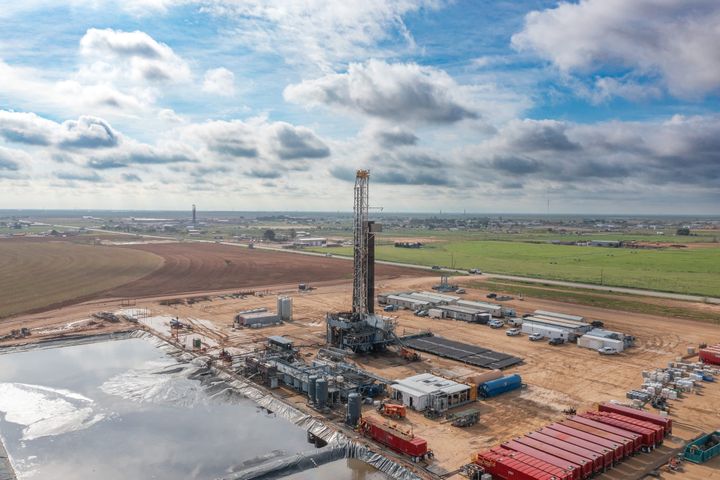
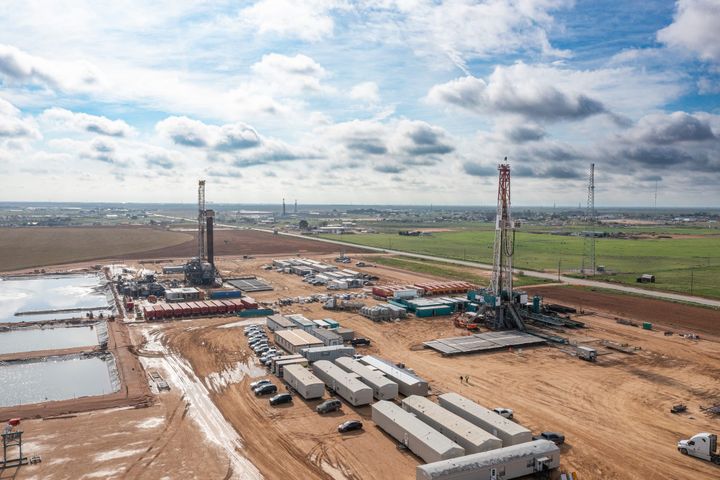
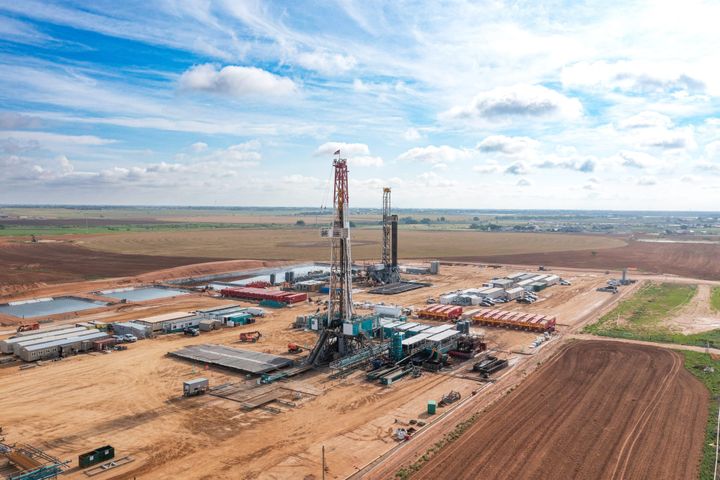
Wednesday's editorial rotation covers capital and regulatory themes, including what the EU storage situation means for drilling and completions demand in the US gas basins. The signal is unambiguous: sustained EU LNG demand at or above current levels requires sustained Haynesville and Appalachian production. That means rig count stability in the dry gas basins, continued completion activity, and midstream infrastructure utilization at or near capacity. H&P's Appalachian AC rig fleet, Nabors' Haynesville contract book, and PTEN's performance drilling exposure to gas basin operators are all downstream beneficiaries of the demand thesis confirmed Wednesday.
The US gas rig count has held steady near 103 to 106 for the past six weeks per EIA data. At $2.82/MMBtu Henry Hub — now trending up from the $2.63 low on May 1 — and with export basis premiums well above the domestic floor, operators have no incentive to cut gas rigs. The EU storage mandate signal removes another reason to hesitate.
CIR Analysis and What To Watch
CIR Analysis: The IAOGP/Eurogas petition is not a gas market footnote. It is a European government confirming, publicly, that it cannot source enough LNG to meet its own storage mandate without sustained US supply. That is a structural demand floor for Haynesville and Appalachian gas that does not expire when the Iran geopolitical premium eventually compresses. EQT and Expand Energy are the two best-positioned large-cap plays to capture this — EQT through MVP-enabled domestic power demand plus LNG contract exposure, EXE through sheer volume scale and the new Delfin FLNG offtake contract.
CIR Analysis: The IEEFA 80% EU dependency forecast in two years is aggressive but directionally correct given the pace of US LNG capacity additions. Even if the actual share lands at 70%, it represents a structurally different demand environment for US gas producers than existed in 2023 or 2024. Hedging programs at $5.00+ NYMEX — EQT is collared at $4.94/$3.50 through Q3 — confirm producers are treating this as a durable environment, not a spike.
What To Watch:
- EU storage injection pace through June — if fill rate tracks below 60% by end of June, the Commission flexibility petition gains political force and LNG contract discussions accelerate
- EXE Delfin FLNG Vessel 1 final investment decision timeline — the 20-year SPA is conditional on FID, currently targeted for 2026
- EIA weekly storage report Wednesday — current US storage at 2,205 Bcf (May 1) is tracking below 2025 comparable period of 2,255 Bcf; a sustained deficit signals domestic demand is absorbing more supply than expected, bullish for basis
- H&P and Nabors rig count activity in Haynesville and Northeast PA through Q2 reporting
Disclosure: The author/publisher holds positions in EQT and EXE as of the publication date. This does not constitute investment advice.
Crude Intelligence Report is an independent upstream oil and gas intelligence publication. The content in this article is for informational purposes only and does not constitute investment advice, financial advice, or a recommendation to buy or sell any security. Always conduct your own due diligence before making investment decisions. CIR and its contributors may hold positions in companies mentioned; any such positions will be disclosed when known. © 2026 Crude Intelligence Report. All rights reserved.
This article contains forward-looking statements and analytical opinions. Actual results may differ materially.