Drilling Contractors at the $98 Threshold: H&P, PTEN, Nabors and Whether the Day-Rate Thesis Survives

HP | NYSE | PTEN | NASDAQ | NBR | NYSE | Source data: Baker Hughes US rig count (week ending May 16, 2026), Helmerich & Payne Q2 FY2026 guidance (SEC 8-K), Patterson-UTI Q1 2026 10-Q, Nabors Industries Q1 2026 10-Q, EIA Drilling Productivity Report May 2026, FRED DCOILWTICO WTI daily close
The drilling contractor re-rating thesis for 2026 was built on a simple premise: WTI sustaining above $100 would finally give operators the confidence to sign multi-year, performance-based contracts at day rates that reflect the real cost of operating a premium fleet. WTI at $98.44 Wednesday — down $5.73 in a single session on a Trump diplomatic comment — doesn't break that thesis. But it narrows it, and the margin for error has shrunk.
The Day-Rate Setup Entering May
Per Baker Hughes rig count data for the week ending May 16, 2026, the US oil-directed rig count stood at 415, up 5 week-over-week and up from the 2026 year-to-date low of 406. Total US rig count ran 551. The Permian Basin specifically accounted for 308 rigs — flat week-over-week.
All three major drilling contractors entered this week with their 2026 earnings re-rating story largely intact:
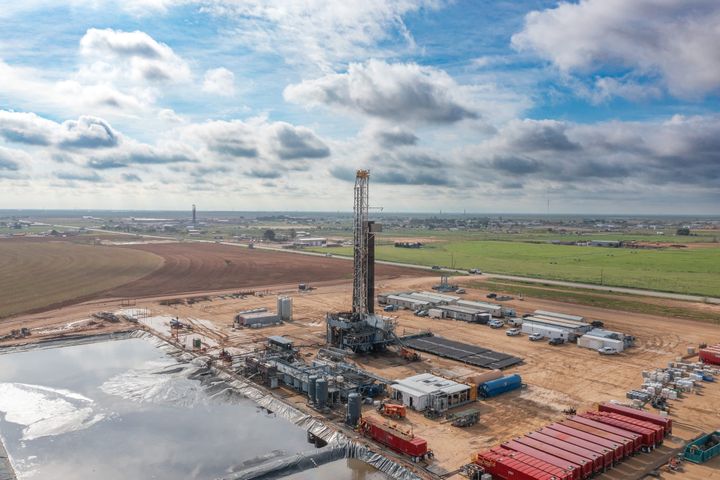
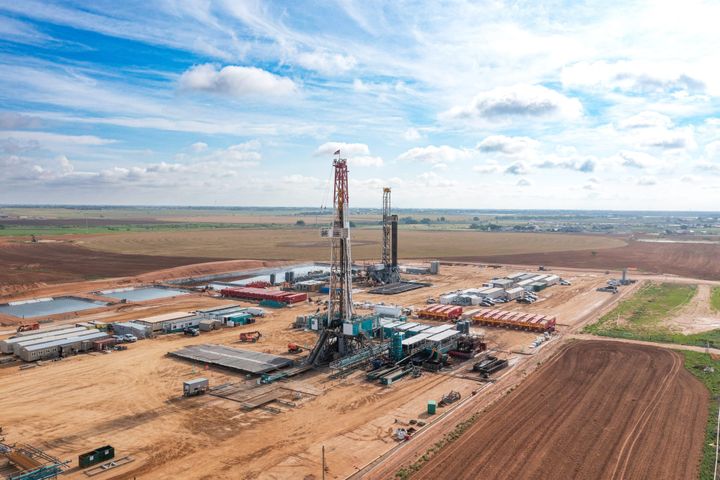
Helmerich & Payne (HP): The US land drilling leader. Per H&P's most recent quarterly guidance, North America Solutions day rates averaged $35,000-37,000/day in Q2 FY2026 (fiscal quarter ending March 31), with FlexRig premium utilization above 85%. H&P has been executing on its "super-spec" fleet strategy — retiring older rigs and focusing revenue on AC-drive, pad-optimal equipment that operators need for modern multi-well pads. That fleet quality premium has insulated H&P from day-rate pressure better than competitors with less differentiated equipment.
Patterson-UTI Energy (PTEN): The merged Patterson-UTI/NexTier entity has been working through integration through Q1 2026. Per PTEN's Q1 2026 10-Q filing, US drilling revenue came in at approximately $480M, with contract drilling utilization at roughly 72% of marketed fleet. The completion services segment — NexTier legacy frac and coiled tubing — has been the more volatile piece, but the drilling segment has maintained day rates above $32,000/day on average for super-spec equipment.
Nabors Industries (NBR): The most international-weighted of the three. Nabors' US Lower 48 segment has approximately 68-72 marketed rigs, with international exposure providing revenue stability through commodity price cycles. Per Nabors' Q1 2026 10-Q, international revenue represented approximately 65% of consolidated revenue — a structural hedge that H&P and PTEN don't have to the same degree.
The $98 Threshold: Where the Thesis Gets Tested
The drilling contractor re-rating thesis has a specific price floor embedded in it. At $100+ WTI, Permian operators maintain or modestly increase rig counts. At $95-100, activity is flat-to-down 2-3% on a seasonal basis. Below $95, the historical pattern is a -5 to -8% rig count move within 60 days, as operators defer non-obligated spuds and allow maturing contracts to expire without renewal.
CIR Analysis: Wednesday's $98.44 close puts the market in the flat-to-cautious zone, not the contraction zone. The Permian rig count's stability at 308 through recent weeks at $103-107 WTI suggests operators built their 2026 programs around $95-100 base cases, not $110. That's actually constructive for day-rate stability — operators running programs designed for $95 don't pull rigs at $98. They only pull rigs when prices break below their modeled floor, which for most Permian operators sits at $85-90.
Contract Structure: Where Day Rates Are Heading
The market for super-spec US land rigs in May 2026 looks like this, per Baker Hughes data and H&P/PTEN public disclosures:
$35,000-38,000/day: Super-spec AC-drive rigs on 12-24 month performance contracts with leading-edge operators (majors, super-independents). These rates have been stable since Q3 2025 but haven't broken significantly higher despite the WTI rally from $85 to $112.
$28,000-34,000/day: Standard-spec and legacy-AC rigs on shorter-term contracts with mid-tier operators. This market is more volatile and represents the segment most at risk if WTI spends more than 2-3 weeks below $95.
CIR Analysis: The absence of a meaningful day-rate breakout above $38,000 during the WTI rally from $87 to $112 tells you something important about operator negotiating posture. E&P procurement teams used the commodity rally to lock in favorable terms — operators signed more performance-based contracts with day rates indexed to operational efficiency metrics, rather than accepting straight day-rate increases. That structure protects drilling contractor revenue on the downside (utilization stays high) but caps upside on individual contract pricing. It's a services-sector version of the hedging paradox.
Wednesday's Service Beat: Drilling Automation and MWD/LWD
Wednesday's service beat theme is drilling automation and measurement while drilling (MWD/LWD). This is where H&P's ICE architecture and Nabors' PACE-X platform represent the premium tier of the US land market. H&P's autonomous drilling capability — controlling weight-on-bit, RPM, and standpipe pressure in closed-loop without driller input — reduces drilling time per well by 8-15% on measured depth, per H&P's own published performance benchmarks from their FlexRig deployments.
For MWD/LWD: SLB's AziTrak and EcoScope tools, and Halliburton's LithoTrak and EarthStar packages, represent the current performance ceiling on formation evaluation while drilling. As Permian wells get longer — laterals now routinely exceed 15,000 feet — the quality of MWD/LWD data becomes the differentiator between a well that lands optimally in the target zone and one that wastes 10-15% of its lateral length in nonproductive rock.
CIR Analysis: The drilling automation story for 2026 is a margin recovery play hidden inside an activity story. Drilling contractors that own the automation IP (H&P through its iCampus platform, Nabors through PACE-X) are capturing more revenue per rig-day through technology premiums layered on top of the base day rate. At $98 WTI, that premium matters more — it's the difference between a breakeven rig and a profitable one for the contractor.
What To Watch
- H&P Q3 FY2026 guidance (reporting late May): If H&P holds its utilization guidance and doesn't guide down day rates, the re-rating thesis survives the current price volatility intact.
- Permian rig count week-over-week: Two consecutive weeks of Permian rig count decline below 300 would be the market signal that operators are responding to prices, not just weather noise.
- PTEN contract renewal announcements: Any disclosure of early contract terminations or deferrals in PTEN's NexTier completion services book would suggest operator commitment to H2 2026 programs is weaker than current public guidance implies.
- Nabors international contract wins: A significant Middle East or Latin America contract award would insulate NBR from US land market volatility and re-rate the stock on international exposure alone.
CIR Verdict
At $98 WTI, the drilling contractor day-rate recovery thesis is intact but on probation. H&P's fleet quality premium, PTEN's scale in the integrated drilling-and-completion space, and Nabors' international diversification all provide buffers against a $5-10 WTI move. The thesis breaks if WTI sustains below $92 for 4+ weeks — that's the level where operators start making real activity decisions, not just absorbing volatility. Until then, this is noise the market has been trained to ignore at $100+ WTI environments.
Crude Intelligence Report is an independent upstream oil and gas intelligence publication. The content in this article is for informational purposes only and does not constitute investment advice, financial advice, or a recommendation to buy or sell any security. Always conduct your own due diligence before making investment decisions. CIR and its contributors may hold positions in companies mentioned; any such positions will be disclosed when known. © 2026 Crude Intelligence Report. All rights reserved.
This article contains forward-looking statements and analytical opinions. Actual results may differ materially.