Devon-Coterra: What the Vote Today Means for the Deal That Remakes the Delaware Basin
Devon and Coterra shareholders vote today on a merger priced when WTI was in the low $40s. With crude at $107, the deal's free cash flow math has fundamentally changed — and the combined asset map is what analysts should be studying.
DVN | NYSE | CTRA | NYSE | Source data: Devon Energy 8-K (Feb 2, 2026) Merger Agreement; Devon Energy Q4 2025 earnings release (Feb 17, 2026); Coterra Energy Q4 2025 earnings release (Feb 26, 2026); Devon 8-K supplement (Apr 24, 2026); EIA WTI price series
Shareholders at Devon Energy and Coterra Energy vote today on a merger that was priced at Midland crude in the low $40s per barrel and is being decided with WTI at $107. The commodity backdrop has flipped so completely that the original case for the deal — enhanced free cash flow in a sub-$70 environment — almost undersells what the combined company would look like at current strip prices. That gap between the deal's design environment and today's market reality is the central analytical fact of this vote.
Deal Structure at a Glance
Devon and Coterra signed a definitive merger agreement on February 1, 2026. The terms: each Coterra share converts to 0.70 Devon shares, no cash component. Devon shareholders retain approximately 54% of the combined company on a fully diluted basis; Coterra shareholders hold the remaining 46%. The combined company keeps the Devon Energy name and the DVN ticker, lists on the NYSE, and operates out of Houston.
Governance is split between the two legacy teams. Clay Gaspar, Devon's current president and CEO, stays in the CEO role and runs the combined company's day-to-day. Tom Jorden, who built Coterra's Delaware Basin-weighted portfolio, steps into the Board Chair position. The eleven-member board will include six Devon designees and five Coterra designees. A two-year corporate governance compact — requiring 75% board supermajority to remove either the Chair or CEO — locks in leadership continuity through the integration period.
The transaction carries an $865 million termination fee on either side. Two shareholder lawsuits were filed alleging proxy disclosure deficiencies (Goggin v. Devon Energy Corp. and Kelly v. Devon Energy Corp., both in New York Supreme Court). Devon supplemented the proxy on April 24, 2026 without admitting liability. Neither suit sought an injunction, and neither disrupted the vote timeline. Both special meetings proceed at 10:00 a.m. CT today, May 4.
What Each Company Brings to the Table
Devon entered this deal from a position of operational strength. Q4 2025 production came in at 851,000 boe/d, with oil at 390,000 bbl/d — 46% of total volume and above the top end of guidance. The Delaware Basin drove the beat. Capital of $883 million came in 4% below guidance midpoint. Free cash flow for the quarter was $702 million; operating cash flow $1.5 billion. Net debt stands at $8.4 billion at a leverage ratio of 0.9x net debt/EBITDAX. Proved reserves reached 2.4 billion boe at year-end 2025, with a 193% production replacement rate. Devon ran 19 operated rigs and 4 completion crews in Q4, drilling wells averaging 10,200-foot laterals.
Coterra's value proposition is different. Its 2025 free cash flow totaled $2.0 billion — up 67% year-over-year — on a 54% reinvestment rate, one of the most capital-efficient structures in the independent E&P space. Proved reserves hit 2,565 MMBoe at year-end 2025, up 13% year-over-year, partly reflecting the integration of 2025 Delaware Basin acquisitions. Net debt/EBITDAX was 0.8x at year-end. The 2026 standalone guidance — 750 to 810 MBoepd total, 162 to 172 MBopd oil — reflects continued operational momentum. Coterra's three-basin structure (Permian Delaware, Marcellus, Anadarko) gives the combined company breadth Devon's single-basin Delaware focus never had.
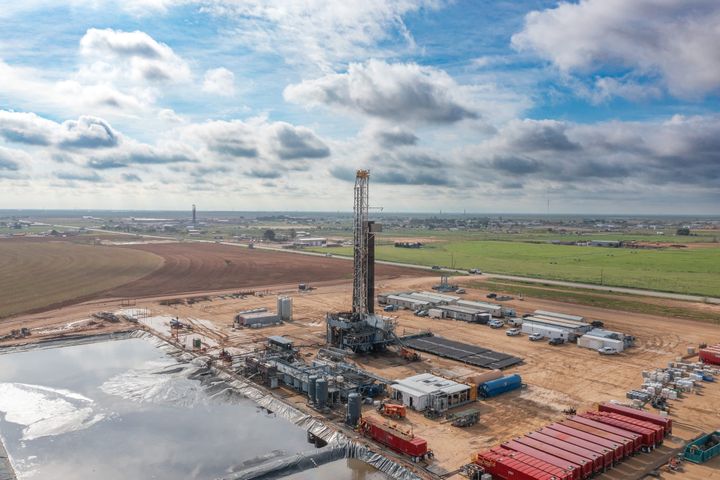
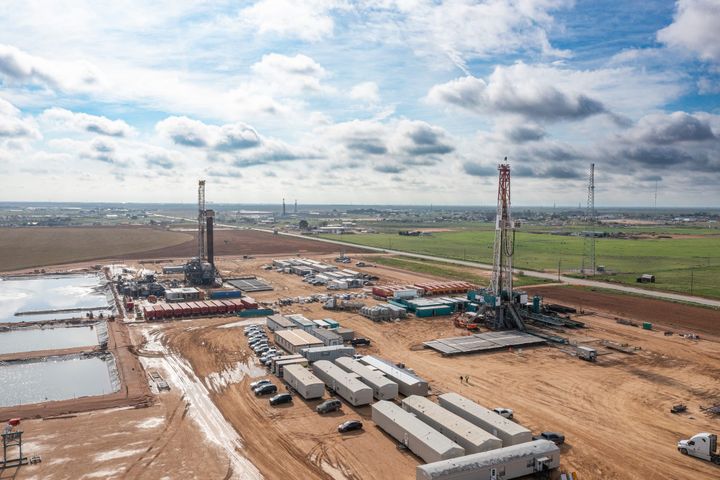
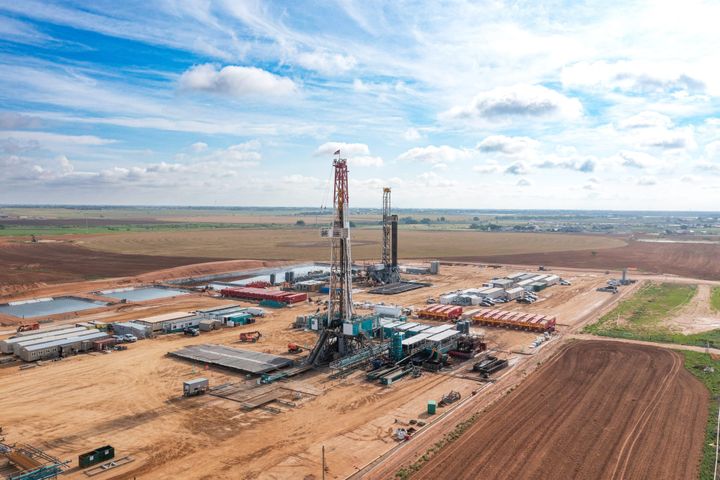
CIR Analysis: The key insight on the asset overlap is not redundancy — it's complementarity. Devon is long Delaware Basin oil-weighted acreage. Coterra adds Marcellus gas exposure (increasingly valuable at $4+ Henry Hub), Anadarko optionality, and a lower-cost capital structure. The combination diversifies Devon's commodity mix without diluting its Delaware Basin core. At $107 WTI and elevated natural gas prices, the blended portfolio's free cash flow potential is dramatically higher than either company modeled when they signed in February.
The $107 Context
The exchange ratio was fixed at 0.70 DVN shares per CTRA share on February 1, when Devon traded at $39.45 and Coterra at $27.52. That implied deal value was roughly $19.26 per Coterra share — a modest premium to CTRA's undisturbed price at signing.
With WTI gapping to $107 today, both stocks have moved substantially from their signing prices. The all-stock structure means Coterra holders receive the same 0.70 ratio regardless of where DVN trades — the effective premium or discount to standalone value has repriced with the commodity. This is a feature of all-stock deals: both sides participate in commodity upside equally, without the acquirer having to fund an elevated cash offer in a rising market.
CIR Analysis: The timing optics have inverted. When the deal was announced, skeptics argued Devon was paying a full price in a weak crude environment. At $107 WTI, that criticism has no remaining traction. The deal that is in front of voters today is a tie-up between two strong-balance-sheet operators at terms the commodity market would have considered conservative two months ago.
The Synergy Math
The companies are targeting $1.0 billion in sustainable annual pre-tax synergies by year-end 2027. Devon has separately been executing a $1.0 billion business optimization program, with 85% of that target achieved by year-end 2025. The synergy capture runs in parallel — effectively doubling the structural cost improvement already underway at Devon's standalone operations.
The primary levers: overhead consolidation across two previously separate executive structures, drilling and completions procurement scale (combined lateral footage purchasing power across Delaware Basin, Marcellus, and Anadarko operations), midstream optimization across shared Delaware Basin infrastructure, and G&A rationalization across two Houston-headquartered companies already operating in overlapping basins.
At $1.0 billion annualized, the synergy value at a 5x EV/EBITDA multiple would add roughly $5 billion to the combined enterprise value. That value is not priced into the current exchange ratio because it doesn't exist yet. It's the integration premium voters are effectively endorsing today.
What Happens If the Vote Passes
Assuming both Devon and Coterra shareholder votes clear today — the more likely outcome given both boards unanimously recommend approval — the closing timeline targets Q2 2026. The Form S-4 was declared effective by the SEC on March 26. Post-close, the combined company will issue updated full-year guidance reflecting the merged entity's production base and capital program.
Devon has indicated it will increase its quarterly dividend to $0.315 per share following close — a 31% increase from the current $0.24/quarter rate — and establish a new share repurchase program in excess of $5 billion. Both commitments are subject to board approval post-close but reflect management's capital return ambitions at current commodity prices.
What To Watch
- Vote outcome announcement expected this afternoon, May 4 — look for 8-K filings from both DVN and CTRA confirming results
- Combined company full-year production guidance: first look at the merged asset base at $100+ WTI, expected shortly after close
- Delaware Basin integration timeline: shared infrastructure, midstream contracts, and G&A headcount rationalization will determine how quickly the $1.0B synergy run-rate materializes
- Dividend and buyback authorization: post-close capital return policy sets the income investing thesis for the combined DVN at current strip
- Marcellus and Anadarko capital allocation: Coterra's non-Permian assets could see significant reallocation depending on commodity mix decisions the combined management team makes in H2 2026
Crude Intelligence Report is an independent upstream oil and gas intelligence publication. The content in this article is for informational purposes only and does not constitute investment advice, financial advice, or a recommendation to buy or sell any security. Always conduct your own due diligence before making investment decisions. CIR and its contributors may hold positions in companies mentioned; any such positions will be disclosed when known. © 2026 Crude Intelligence Report. All rights reserved.
This article contains forward-looking statements and analytical opinions. Actual results may differ materially.