Water Management: The Permian's Billion-Dollar Problem

Issue 11 | April 10, 2025 Category: Operations & Infrastructure Access: Paid
Oil gets the headlines. Water runs the operation — or shuts it down.
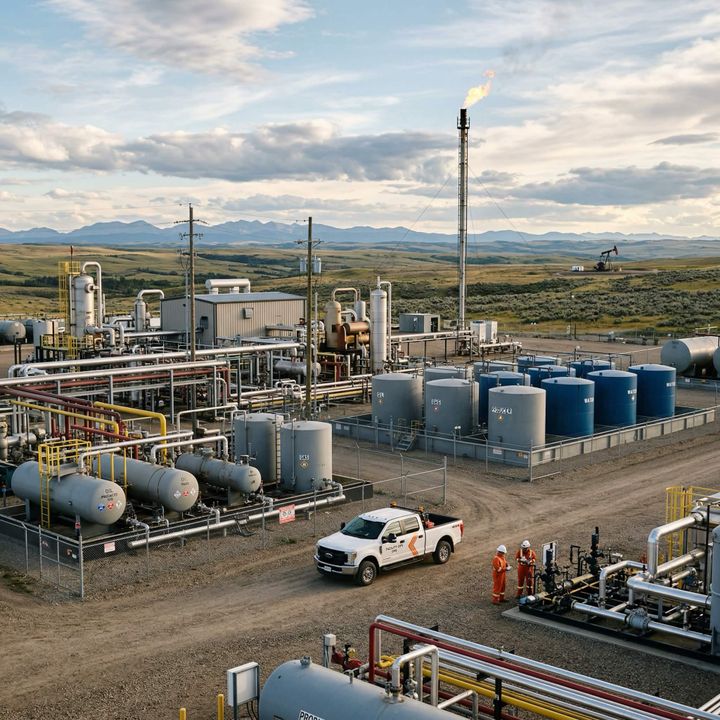
For every barrel of oil the Permian Basin produces, operators bring to surface somewhere between 3 and 10 barrels of produced water. At current basin output of roughly 6.8 million barrels of oil per day, that's upward of 50 million barrels of water flowing through the system every 24 hours. Handling that water — safely, economically, and in compliance with tightening regulation — has become one of the most consequential operational challenges in U.S. upstream.
This is not a new problem. It's a growing one.
The Math Is Relentless
Produced water volumes don't scale linearly with production — they scale faster. In the Permian's older sub-basins, water-to-oil ratios (WOR) have climbed steadily as reservoir pressure depletes and formations mature. The Delaware Basin in particular has seen WOR increases that outpace production growth in many legacy development areas. New drill locations in the Wolfcamp and Bone Spring often start life with manageable water cuts, but within 12–24 months, water production can double while oil rates decline on the natural depletion curve.
The practical consequence: operators are spending more per BOE on water handling as their portfolios age. Industry estimates put produced water disposal costs in the Permian at $0.50–$1.50 per barrel of water, depending on proximity to disposal infrastructure and local competition for well capacity. Scale that across 50 million barrels per day and you're looking at $25–75 million in disposal costs per day, basin-wide. Per year: north of $10 billion.
That number tends to focus minds.
Disposal Well Capacity: Where the Constraints Live
The dominant water handling solution in the Permian has been saltwater disposal (SWD) wells — drilled into deep saline formations (typically the Ellenburger in the Delaware, Santa Rosa in the Midland) where produced water can be injected at high volumes. For years, new SWD well capacity kept pace with production growth.
That dynamic is tightening.
In the Delaware Basin (New Mexico side): The Eddy and Lea County SWD infrastructure is showing strain. Injection zones are seeing increased pore pressure in some areas, and permitting new disposal wells on federal land in southeastern New Mexico has become materially slower under BLM policy changes. Operators with large federal acreage positions — Devon, Matador, Coterra, and smaller private operators — face longer lead times to bring on disposal capacity.
Induced seismicity risk: The west Texas Delaware Basin doesn't face the same seismicity concerns as Oklahoma's SCOOP/STACK, but the New Mexico portion has drawn increasing scrutiny. NMOCD (New Mexico Oil Conservation Division) has implemented pressure limits on certain injection intervals and requires more detailed monitoring at some facilities. Any regulatory escalation here would significantly constrain disposal capacity.
Midland Basin: Generally better positioned than the Delaware. The Spraberry/Wolfcamp stack is flanked by robust SWD infrastructure, and the Ellenburger disposal interval has held up. Still, volume growth is persistent, and concentration of disposal activity in some sub-areas has prompted precautionary permit reviews.
The Recycling Equation
The alternative to disposal is recycling — treating produced water for reuse in hydraulic fracturing operations. It sounds like the elegant solution: instead of hauling water to a disposal well, put it back to work completing the next well.
The economics are increasingly competitive. Recycling costs vary by treatment level required, but basic filtration for frac reuse typically runs $0.20–$0.50 per barrel — cheaper than disposal in many constrained markets. Several large Permian operators have built out dedicated water recycling infrastructure:
Diamondback Energy has made recycling a centerpiece of its water strategy, with centralized treatment facilities on its Midland Basin acreage and targets to recycle >50% of its frac water demand. The Endeavor assets they acquired bring additional infrastructure and scale advantages.
ConocoPhillips has quietly built one of the more sophisticated water management systems in the Delaware, with closed-loop recycling networks and multi-operator sharing agreements in parts of its Permian position.
Pioneer Natural Resources (now ExxonMobil) had invested heavily in water infrastructure across its Midland Basin operations — infrastructure XOM inherited in the 2024 acquisition and is now expanding under its typically methodical capital deployment approach.
The challenge is that recycled water economics only work at scale and with infrastructure already in place. For smaller operators without centralized gathering systems, the capital cost of building recycling infrastructure is prohibitive relative to their production base.
The Infrastructure Buildout Race
Third-party water midstream has emerged as a capital-intensive infrastructure sector in its own right. Several dedicated players are competing for long-term water handling agreements with Permian producers:
WaterBridge operates one of the larger independent water infrastructure networks in the Delaware Basin, with disposal, recycling, and transfer capacity across New Mexico and West Texas. They've pursued multi-operator agreements that allow them to balance loads across their network.
Nuverra Environmental Solutions has Permian exposure alongside its other water service operations. Nuverra is smaller and has faced balance sheet challenges historically, but its operational footprint is meaningful in certain areas.
EPIC Midstream — better known for its oil pipeline — has a water logistics operation in the Permian as well, leveraging its right-of-way footprint.
The fundamental value proposition of third-party water midstream is simple: operators don't want to own water infrastructure. It's capital that earns midstream-type returns, not upstream returns. Contracting with a dedicated water midstream operator lets E&Ps focus their capital on the reservoir — which is the right capital allocation decision, even if it creates a cost-per-barrel dependency.
New Mexico Regulatory Pressure
The regulatory dimension is sharpening. New Mexico, which hosts the most prolific Delaware Basin acreage, has been more aggressive than Texas in tightening water disposal oversight. Key developments:
- NMOCD injection pressure limits have been applied to specific Ellenburger injection zones in Eddy County, reducing per-well disposal rates for some operators
- Environmental groups have escalated litigation around oilfield water disposal permits, causing some permitting delays even when applications are technically compliant
- Produced water recycling mandates are under discussion at the legislative level — not yet passed, but the political direction is clear
Texas regulators (RRC) have historically been more permissive, and the Midland Basin benefits from that regulatory environment. The Delaware Basin straddles the state line, and operators with heavy New Mexico exposure are building in additional infrastructure investment to handle regulatory risk.
What It Costs Operators
Water management is increasingly a line-item disclosure in investor presentations, and the range is wide. Best-in-class operators in the Midland Basin with mature recycling infrastructure report all-in water costs of $0.40–$0.70 per BOE. Operators in the Delaware without recycling infrastructure and in constrained disposal markets can see $1.20–$1.80 per BOE.
On a 100,000 BOE/d production base, that $1/BOE spread is $36 million per year. It's real money — and it compounds with volume growth.
The operators solving this problem cheapest aren't just saving on opex. They're building a durable cost advantage that shows up in the only metric that actually matters: cash margins per barrel.
The Bottom Line
Water management is transitioning from a mundane operating cost to a genuine competitive differentiator in Permian operations. Operators who built integrated water infrastructure early — or who've made strategic decisions to outsource to capable third parties — have structural cost advantages over those still managing water well-by-well. As disposal constraints tighten, especially on the New Mexico side of the Delaware, the premium on water infrastructure quality will only increase.
This isn't a headline risk. It's a slow-moving operational story that shows up in margin comparisons and long-term well economics. Watch for increased water infrastructure capital disclosures in 2025 10-Ks — it's becoming a required disclosure rather than a footnote.
CIR will continue tracking produced water infrastructure developments alongside basin activity updates. Data referenced reflects publicly available operator disclosures, NMOCD filings, and industry analyst estimates current as of Q1 2025.
Crude Intelligence Report is an independent upstream oil and gas intelligence publication. Content is for informational purposes only and does not constitute investment advice, financial advice, or a recommendation to buy or sell any security. Always conduct your own due diligence before making investment decisions. The author and publisher hold no positions in any companies mentioned in this article. © 2026 Crude Intelligence Report. All rights reserved.