OPEC at a 26-Year Low, Kuwait at Zero: What Monday's Close Tells Operators About This Week
OPEC's April production hit a 26-year low at 20.04 million bpd. Kuwait exported zero crude for the first time since the Gulf War. Trump-Xi talks in Beijing this week are the market's live variable.

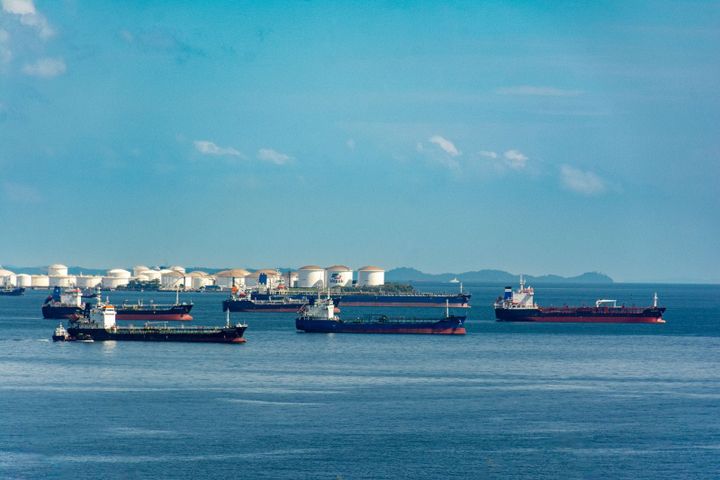
OPEC's April production survey, published Monday by Reuters, put cartel output at 20.04 million barrels per day. That is the lowest reading since 2000 — a 26-year low — and a drop of 830,000 bbl/d from March. The decline is not a quota decision or a strategic production cut. It is a structural consequence of the Strait of Hormuz blockade, now in its third month, and Monday's WTI settlement near $96.41 confirms the market is not pricing a near-term resolution.
Kuwait's Zero Month
The starkest single data point in the April survey: Kuwait exported zero crude for the month. The last time that happened was August 1990, when Saddam Hussein's invasion shut down the country's entire production and export infrastructure.
Kuwait's geography is the constraint. Its entire export architecture routes through the Strait of Hormuz — the country has no Red Sea terminal, no Gulf of Oman bypass, no alternative pipeline corridor. Unlike Saudi Arabia, which has rerouted barrels via the 1,200-kilometer East-West Pipeline (Petroline) to the Yanbu terminal on the Red Sea, Kuwait had no structural workaround available when the blockade tightened. The April data reflects that reality in full.
The UAE was the only Gulf OPEC member that managed to increase April output. Its Fujairah terminal on the Gulf of Oman gave Abu Dhabi a Hormuz bypass not available to Kuwait, Basra-dependent Iraq, or, to a meaningful degree, the Saudis. The UAE is producing in the 3.2 to 3.6 million bpd range and can theoretically push higher — but it is operating near its effective export ceiling through Fujairah.
Saudi Arabia's Workaround and Its Limits
Saudi production dropped to roughly 7 million bpd in April, down more than 3 million bpd from pre-conflict levels, after infrastructure attacks caused approximately 600,000 bpd of processing capacity damage at key facilities. Petroline is now carrying the full weight of the kingdom's export program. That pipeline has a theoretical capacity ceiling near 5 million bpd, and Yanbu's terminal infrastructure adds throughput constraints on top of that. The Saudis are managing the situation, but not at volume.
CIR Analysis: The April OPEC data functions as a supply-floor confirmation for WTI. The market has not broken below $94 since the conflict began, and the survey quantifies why: there is no readily available swing supply to absorb the loss of 800,000-plus bpd from Gulf OPEC producers. US crude exports are running at record levels — Eagle Ford and Gulf Coast cargoes are moving in volume into Atlantic Basin markets that can no longer source from the Persian Gulf on the same economics — but no combination of non-Hormuz supply bridges a gap of this magnitude indefinitely. The floor is structural, not sentiment.
The Beijing Variable
Monday's closing prices are less important than what happens Thursday and Friday in Beijing. Trump arrives in China on Wednesday for his first state visit since 2017, heading into a two-day summit with President Xi Jinping that carries more direct crude market implications than any bilateral meeting in recent memory.
China has continued purchasing Iranian crude throughout the conflict — the economic lifeline that allows Tehran to sustain the blockade and absorb Western sanctions pressure. Trump rejected Iran's latest peace proposal Monday morning, calling it "totally unacceptable." Brent was up 1.4% to $103.30 per barrel by midday. The Iran file is live, and Beijing holds the key variable.
According to reporting, China is expected to announce purchases of US energy and agriculture at the summit, with Trump pressing Xi on Beijing's Iranian crude purchases in return. There are also reports of an Alaska LNG deal framework and a rare earth minerals truce on the table. Analysts are cautioning against expecting major breakthroughs — but even a joint communiqué that includes ambiguous language about Iranian crude would be read as a shift, and the crude market would respond accordingly.
What to Watch This Week
- Trump-Xi joint statement Thursday or Friday — any language on Iranian crude purchases is the signal. Vague language moves the market; specific commitments move it more.
- WTI through the summit: a hold above $94 heading into Thursday confirms the floor; a break below it suggests the market is pricing in a deal framework before it materializes.
- US crude export data (Wednesday EIA weekly report): tracking whether Gulf Coast loadings are continuing to accelerate into Atlantic Basin demand.
- Kuwait: any announcement of Red Sea or Gulf of Oman bypass infrastructure discussions would be a significant medium-term bearish signal for the Hormuz premium embedded in WTI.
The week opened with OPEC's worst output reading in a generation and a US president boarding a plane to Beijing. For operators running cash flow scenarios, those two data points set the range. The floor is defined by a supply hole nobody can immediately fill. The ceiling depends on whether Trump and Xi find a framework that starts pulling Iranian oil back into the market. Neither resolved on Monday's close.
Crude Intelligence Report is an independent upstream oil and gas intelligence publication. The content in this article is for informational purposes only and does not constitute investment advice, financial advice, or a recommendation to buy or sell any security. Always conduct your own due diligence before making investment decisions. CIR and its contributors may hold positions in companies mentioned; any such positions will be disclosed when known. © 2026 Crude Intelligence Report. All rights reserved.
This article contains forward-looking statements and analytical opinions. Actual results may differ materially.