Hormuz Is Open — For Some: Inside the IRGC's Managed Passage Regime and What It Means for Atlantic Basin Supply
Five tankers cleared Hormuz this week. That's not free passage — it's the IRGC's managed clearance structure in action. What it means for Saudi crude, Atlantic Basin alternatives, and the $90 WTI floor.
Geopolitical | Source data: OilPrice.com, Reuters coverage May 27–28, 2026; FRED DCOILWTICO daily series; EIA U.S. LNG export data; Gas Infrastructure Europe storage data May 27, 2026
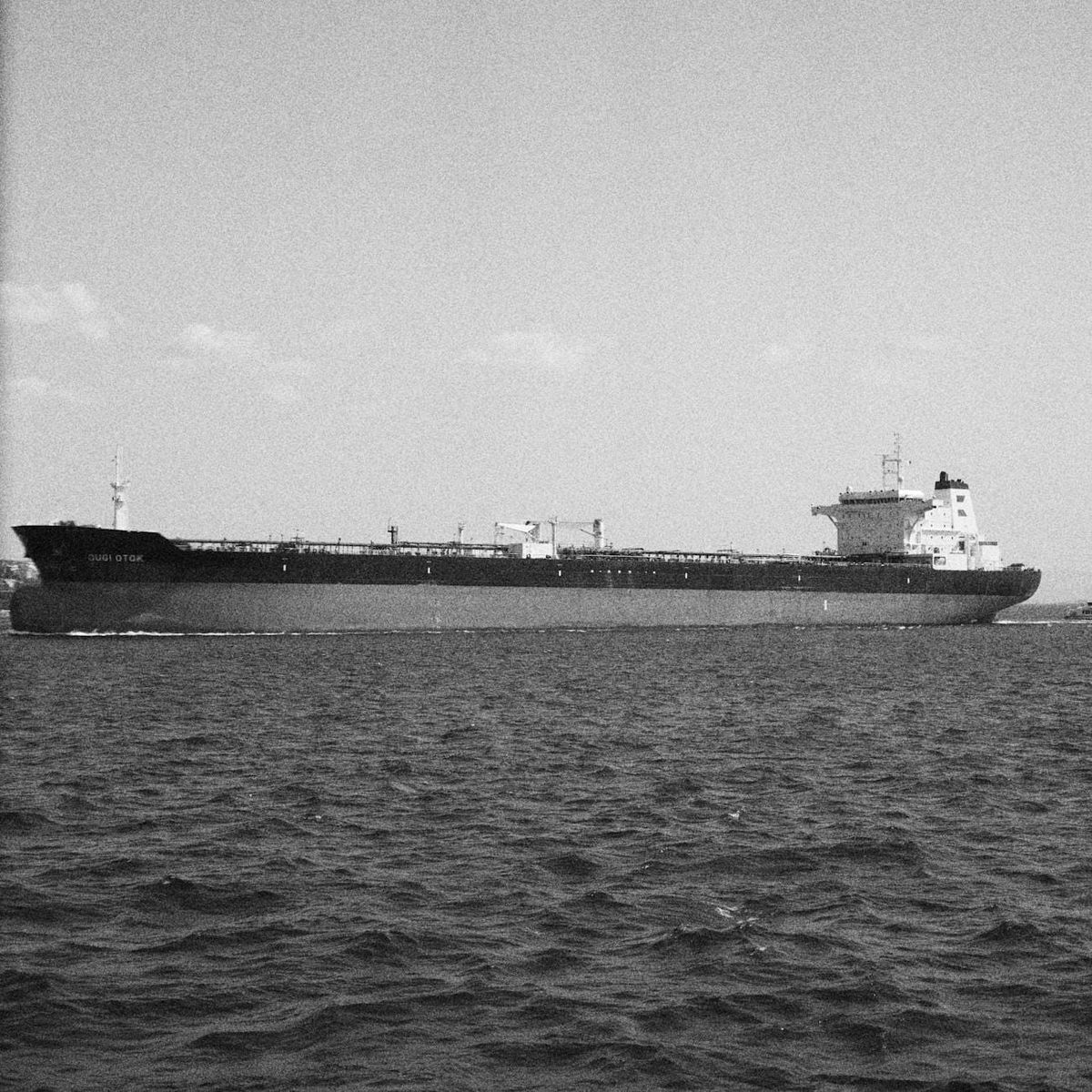
Five vessels — three crude carriers and two gas carriers — cleared the Strait of Hormuz this week. That number is not a victory for free passage. It is a press release from the IRGC.
Every transit requires coordination with Iranian naval forces. Every clearance is a negotiated permission, not a right. And in the gap between those five vessels and the roughly 20 million barrels per day that historically moved through Hormuz on a given week, you can read the entire shape of the current global supply problem.
What "Managed Passage" Actually Means
The Strait of Hormuz is physically open. Ships are not being sunk at random. What Iran has constructed is something more durable and strategically elegant: a selective permission structure that keeps crude flowing just enough to avoid triggering a full military response, while extracting maximum geopolitical leverage from each clearance decision.
State-linked tankers — Saudi Aramco vessels, ADNOC carriers, national company tonnage from regional allies — appear to be receiving priority handling. Commercial operators, spot cargoes, and vessels flagged to countries that have not established bilateral communication channels with Iranian authorities are running higher risk and longer lead times.
CIR Analysis: This is not a blockade. It is a toll booth with an armed customs officer who also decides which vehicles get through. The result from a market standpoint is functionally similar to a partial supply disruption, but one that Iran can calibrate, pause, and restart based on diplomatic conditions. That makes it more persistent than a kinetic blockade would be, and harder to price.
WTI bounced back to $90.17 after the overnight strike news Wednesday, recovering from its brief sub-$90 close Tuesday. According to FRED daily data, WTI settled at $90.17 on May 28 before managed-passage pricing set in. The $90 floor is holding. Brent has held wider: still above $93 as of Thursday morning.
Saudi Crude Is Moving — Slowly and at Ceiling Capacity
The tankers that cleared this week include Saudi crude bound for China and India. That is the predictable pattern: Aramco cargoes get cleared because Iran has a strategic interest in keeping Saudi-China-India crude flows intact — disrupting them damages relationships Iran needs. But that calculus is not infinitely reliable, and Aramco is not moving product freely.
JODI data from March 2026 placed Saudi crude exports at 4.974 million barrels per day, a record low. The Petroline East-West pipeline connects Abqaiq to Yanbu on the Red Sea, bypassing Hormuz, but it has a hard ceiling of approximately 4.5 million barrels per day. Saudi Arabia cannot meaningfully increase Atlantic Basin deliveries without Hormuz cooperation, and it cannot compensate European buyers for supply gaps by rerouting through Yanbu beyond that ceiling.
CIR Analysis: The Petroline bypass has been presented in some coverage as the Saudi solution to Hormuz risk. It is not. It is a partial circuit breaker that maxes out at roughly half of Saudi normal Hormuz-routed export volume. Beyond that volume, Saudi crude either goes through Hormuz or it doesn't go anywhere.
Atlantic Basin Is Improvising
The clearest sign that markets are treating this as a structural, not temporary, supply constraint: European buyers are actively seeking supply diversification at speed. Reuters and OilPrice.com coverage this week confirms that European utilities are in discussions over offtake from Canada's Ksi Lisims LNG project, a facility that was considered a long-dated possibility as recently as six months ago.
The European gas storage picture adds urgency. Germany's gas storage sat at just 30.6% full as of May 27, according to Gas Infrastructure Europe data, well below the 38.65% fill rate at the same point in 2025. Germany's Uniper CEO called for government incentives Thursday morning to accelerate storage injections, warning of potential winter shortages if fill rates don't accelerate. Uniper's concern is not hypothetical: the facility utilization math through October simply doesn't work at current injection rates unless additional supply enters the Atlantic Basin pipeline.
North American LNG is the answer that the physical market is pricing in. The implications for Haynesville and Appalachian producers are significant: any acceleration of LNG offtake demand tightens the domestic basis environment that has been suppressing realized prices for producers like Expand Energy (EXE) and EQT. The Delfin FLNG 20-year SPA that EXE signed last month begins to look more strategically timed than contractually convenient.
What Operators and Service Companies Are Watching
The Hormuz managed-passage regime creates a floor under crude prices that is fundamentally different from demand-driven price support. Demand-driven prices can collapse when the demand story breaks. A geopolitically constrained supply structure is less easily resolved; it requires a diplomatic outcome that currently has no agreed timeline.
For US upstream operators, WTI holding $90+ on a geopolitical floor rather than fundamental supply-demand balance creates different decision calculus than a $90 price supported by strong demand. The operational question is: do you budget H2 completions programs assuming this floor holds, or do you treat it as fragile?
The current market signal, based on JODI data, FRED prices, and the managed-passage pattern, suggests operators hedging a $90 floor are not misreading the situation. The Petroline bypass ceiling means Saudi Arabia cannot fill the Hormuz gap unilaterally. The managed-passage structure means Iran is not choosing to fully close the strait either. The result is a persistent partial constraint — the worst outcome for supply certainty, and the best outcome for price support from the US producer standpoint.
What To Watch
- Weekly tanker clearance count through Hormuz — any move from 5 to 0 or 5 to 15+ signals a regime shift
- European gas storage fill rate through June — Uniper's warning has a real math component, not just a PR component
- Ksi Lisims offtake discussions — if a European utility signs heads of agreement, that confirms Atlantic Basin supply chain reconfiguration is underway
- WTI $90 floor durability heading into June EIA inventory release — the draw pace needs to continue to sustain the floor without the geopolitical premium alone carrying the price
- Any IRGC communication shift regarding commercial vessel clearances — the managed-passage regime is only as stable as Tehran's strategic calculation that partial flows serve their interests better than zero flows
Disclosure: The author/publisher holds positions in EXE and EQT as of the publication date. This does not constitute investment advice.
Crude Intelligence Report is an independent upstream oil and gas intelligence publication. The content in this article is for informational purposes only and does not constitute investment advice, financial advice, or a recommendation to buy or sell any security. Always conduct your own due diligence before making investment decisions. CIR and its contributors may hold positions in companies mentioned; any such positions will be disclosed when known. © 2026 Crude Intelligence Report. All rights reserved.
This article contains forward-looking statements and analytical opinions. Actual results may differ materially.