The Hormuz Test: What One Empty LNG Tanker Tells Us About Global Energy Risk
April 3, 2026 — Houston
The Strait of Hormuz has become the most consequential 33 kilometers in global energy markets. For the first time since the U.S. and Israeli strikes on Iran began on February 28, an LNG tanker has attempted transit of the waterway — and the market is watching every tick of its AIS signal.
The First Move: An Empty Ship Tests the Water
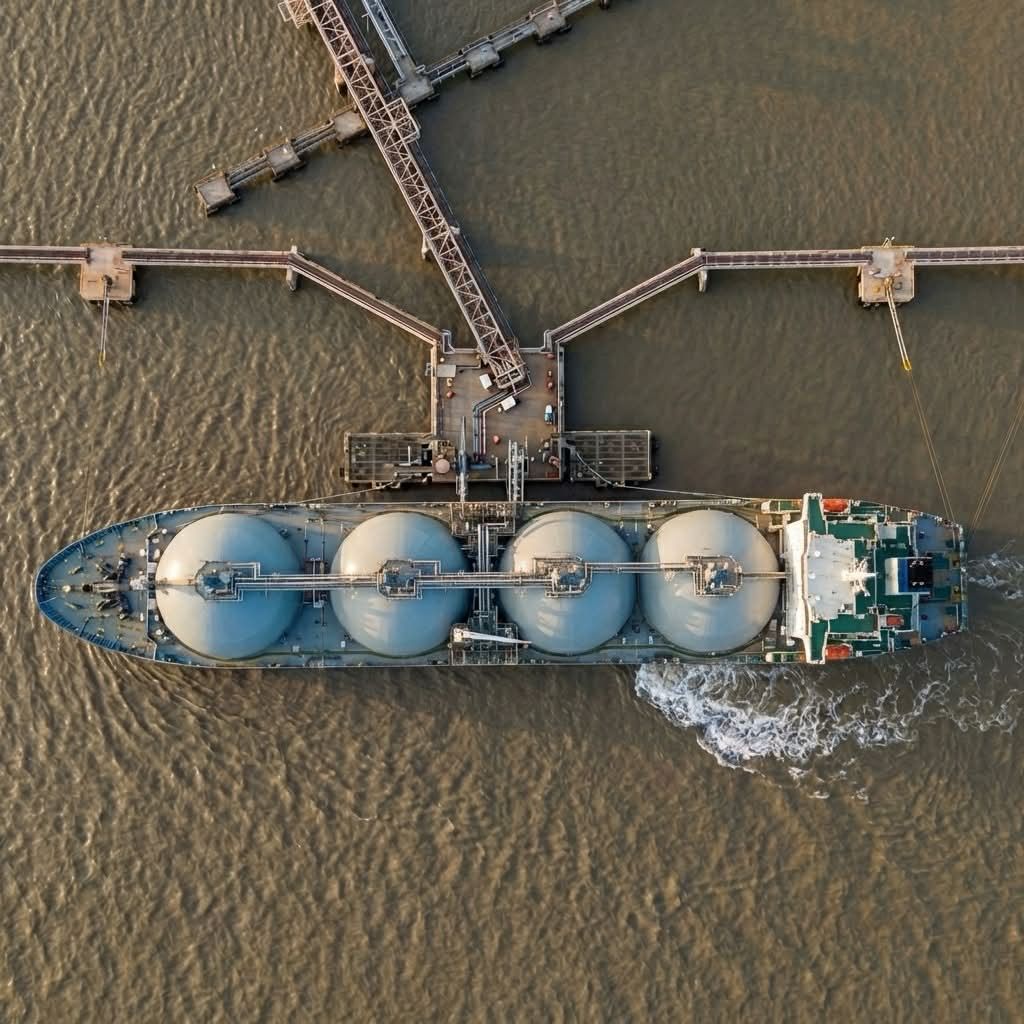
According to Bloomberg, the LNG tanker Sohar exited the Strait of Hormuz on April 2 hugging the Omani coastline — an unusual southern route distinct from the northerly corridors Iran has historically controlled. The vessel, managed by Oman Ship Management Co. and signaling Omani registry, appears to have been unladen. Ship-tracking data reviewed by Bloomberg showed the vessel had been circling in the Persian Gulf for over a month before making the transit run toward the Qalhat LNG export terminal in Oman.
The significance is hard to overstate. According to Bloomberg, LNG ships have avoided the strait entirely since the conflict erupted, disrupting roughly 20% of global LNG flows. A successful transit — even by an empty vessel — opens a psychological crack in what markets have been treating as a total chokepoint.
Oil Price Reaction: From Risk Premium to Physical Threat
According to OilPrice.com, May WTI crude settled at $111.54 on the week ending April 3, a gain of $11.90 or +11.94%. The move reflects a market that has shifted its analytical framework: traders are no longer pricing hypothetical disruption, they are pricing real-time threats to physical supply flows.
The Brent-WTI spread widened at points during the week, a pattern consistent with elevated Middle East export risk premiums. Tanker insurance costs, rerouting delays, and transit fees — some reportedly demanded in yuan or cryptocurrency by Iranian escorts — are effectively creating an invisible reduction in accessible supply even absent a full closure.
ADNOC Calls It "Global Economic Extortion"
Dr. Sultan Al Jaber, Group CEO of ADNOC, escalated his rhetoric in a LinkedIn post on April 2, writing: "Iran's actions in the 33km-wide Strait of Hormuz are not a regional issue. They represent global economic extortion — a threat the world cannot tolerate." According to OilPrice.com, traffic at the strait has been at a near standstill for over a month, with Iran permitting passage largely at its own discretion.
Al Jaber has called on the international community to uphold UN Security Council Resolution 2817, adopted March 11 after 13 members voted in favor while Russia and China abstained — a geopolitical alignment that effectively limits the resolution's enforcement teeth.
Asian LNG Markets Face Structural Stress
According to Natural News, the LNG price spike driven by the Hormuz disruption is accelerating a fuel-switching trend across Asia: utilities and grid operators are increasing reliance on coal-fired power generation as a cost-effective alternative. The Straits Times reported that Asian nations are bracing for a near-complete cutoff of Middle Eastern LNG in the coming days, threatening industrial output and power grid stability across the region.
A cyclone-related outage at Australian LNG export facilities has compounded the supply deficit, removing another source of flexible supply that Asian buyers might have leaned on as a Hormuz substitute.
U.S. Upstream: The Unconventional Opportunity Window
With WTI above $111 and Henry Hub prices elevated by global LNG scarcity, U.S. upstream operators are sitting in an extraordinary price environment. The earnings calendar shows the first major E&P reports arriving in mid-April — Matador Resources (MTDR) on April 22, followed by EQT Corporation and Range Resources on April 21.
CIR Analysis: The Hormuz disruption has functionally created a structural price floor for U.S. LNG exports in the near term. Operators in the Haynesville — a basin with direct pipeline access to Gulf Coast LNG export terminals at Sabine Pass, Calcasieu Pass, and the emerging Plaquemines facility — are among the clearest beneficiaries. The transit attempt by the Sohar suggests the market may be approaching a test of whether Iranian enforcement is absolute or negotiable. If additional vessels successfully transit, the risk premium in both oil and gas could partially unwind. If they are turned back or interdicted, expect another leg higher.
The strategic subplot: U.S. LNG export capacity was already positioned as a geopolitical lever before this conflict. Post-Hormuz, it has become an explicit national security asset. That framing will shape permitting discussions, infrastructure investment, and upstream supply response for years — regardless of how the current standoff resolves.
This article contains forward-looking statements and analytical opinions. Actual results may differ materially.
Crude Intelligence Report is an independent upstream oil and gas intelligence publication. The content in this article is for informational purposes only and does not constitute investment advice, financial advice, or a recommendation to buy or sell any security. Always conduct your own due diligence before making investment decisions. CIR and its contributors may hold positions in companies mentioned; any such positions will be disclosed when known. © 2026 Crude Intelligence Report. All rights reserved.