Natural Gas Winter Setup: Storage, Demand, Price Forecast

Every October, the natural gas market shifts its gaze from summer cooling demand to the winter heating season ahead. The transition involves a familiar analytical checklist: storage levels relative to five-year averages, early weather forecasts from NOAA's Climate Prediction Center, demand expectations from power generation and industrial users, and the increasingly critical overlay of LNG export volumes. As October 2025 unfolds, the setup presents a market that is better-positioned for a winter price spike than it has been at any point since 2022 — but structural supply growth continues to dampen the upside.
Storage: The Starting Point
The Energy Information Administration's weekly storage reports provide the market's most closely watched data point heading into winter. As of early October 2025, total U.S. working gas in storage is approximately 3.5 trillion cubic feet (Tcf) — roughly in line with the five-year average and about 4% above the five-year average for this time of year. The market entered October with a more comfortable cushion than the scary-low levels seen heading into winter 2022, when storage deficits contributed to Henry Hub prices briefly touching $9/MMBtu.
The composition of storage matters as much as the aggregate. Mountain region storage is running slightly below average, which matters because harsh winters in the Rocky Mountain states can strain regional supply-demand balances. South Central storage — the Lone Star State's massive underground storage fields and salt caverns — is adequate. Northeast storage, fed primarily by Appalachian production, is well-supplied.
If the winter draws as expected, storage should bottom around 1.5–1.7 Tcf by March 2026 — not alarming but leaving less margin for error than storage bulls would prefer.
LNG: The Changed Equation
The most significant structural change to the U.S. natural gas demand picture since 2021 is the growth of LNG export capacity. Sabine Pass, Corpus Christi, Cove Point, Calcasieu Pass, and the newly commissioned Plaquemines LNG facility collectively provide roughly 14–15 Bcf/d of export capacity as of late 2025. This is demand that didn't exist four years ago, and it has fundamentally recalibrated the domestic supply-demand balance.
During the 2021–2022 storage build season, LNG exports averaged around 10 Bcf/d. Today, with Plaquemines ramping and Sabine Pass operating at full utilization, exports are running 13–14 Bcf/d. The incremental 3–4 Bcf/d of sustained demand has been one of the primary factors that prevented prices from collapsing further during the storage overhang of late 2023 and early 2024.
For the 2025–2026 winter specifically, LNG export demand is unlikely to flex lower — European buyers are committed under term contracts that incentivize cargo liftings regardless of near-term Henry Hub prices. This creates a demand floor for domestic gas pricing that provides modest structural support even if the winter proves mild.
Supply: Still the Problem
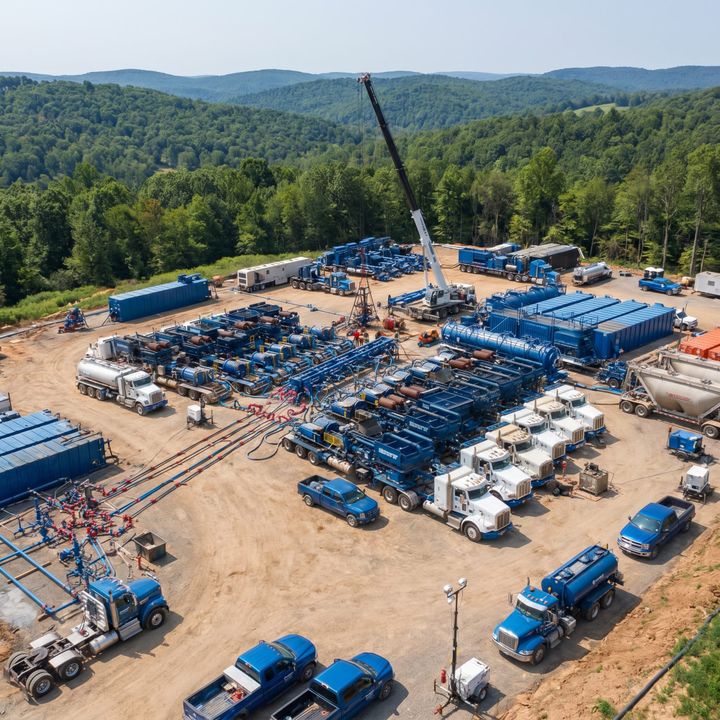
The bear case for natural gas prices rests on supply. U.S. dry gas production is running at approximately 103–105 Bcf/d, near all-time record levels. Appalachian Basin production from EQT Corporation, Coterra Energy, and CNX Resources continues flowing at near-maximum rates. The Haynesville shale in Louisiana and East Texas — now recognized as the primary LNG feeder basin — is generating 15+ Bcf/d despite a reduced rig count, as producers have improved productivity per rig substantially.
The equilibrium that has kept Henry Hub pinned in the $2.00–2.75/MMBtu range for most of 2024–2025 is essentially supply that has grown faster than incremental LNG export capacity. EQT, the country's largest natural gas producer, has explicitly described its production strategy as managing output to market conditions — the company deferred completions in early 2024 when prices were most depressed. This kind of supply-side discipline from the largest producers provides a partial floor, but it hasn't been sufficient to drive a sustained price recovery.
Demand Wild Cards
Beyond LNG exports and residential/commercial heating demand, two demand variables deserve attention heading into winter 2025. First, power generation. The proliferation of data centers driven by AI computing demand has created a surge in electricity consumption that utilities are scrambling to meet. Natural gas generation — dispatchable, fast-responding, and relatively efficient — is the primary beneficiary of this load growth in markets where renewable build-out hasn't kept pace. EIA data shows gas-fired generation up roughly 8% year-over-year through August 2025.
Second, industrial demand. Ammonia production, steel manufacturing, and LNG liquefaction plant heat rejection all contribute to industrial gas demand that is price-sensitive but generally sticky in the short term. U.S. industrial gas demand has been recovering from the doldrums of 2023 as manufacturing activity has improved. A continuation of this trend adds incremental baseload demand that reduces storage withdrawal needs and supports prices at the margin.
Price Forecast
CIR's base case for Henry Hub through winter 2025–2026 is a trading range of $2.75–3.75/MMBtu, with the center of the distribution around $3.10–3.20. This represents a meaningful improvement over the $2.10–2.40 price environment of the prior 12 months but falls well short of the $4+ levels needed to make gas-weighted producers genuinely excited about ramping activity.
The upside scenario — a cold winter similar to 2013–2014's polar vortex conditions — could push Henry Hub to $4.50–6.00/MMBtu in event-driven spikes. The downside scenario — a warm January-February following La Niña-influenced mild temperatures — keeps prices in the $2.50–2.75 range and prevents any meaningful storage deficit from developing.
For upstream operators with material gas exposure — Coterra, Chesapeake/Expand Energy, EQT, CNX — the winter setup is better than it has been, but the structural supply overhang remains the ceiling. Gas-weighted operators are not out of the woods yet; they're simply in a less dense part of the forest.
Crude Intelligence Report is an independent upstream oil and gas intelligence publication. Content is for informational purposes only and does not constitute investment advice, financial advice, or a recommendation to buy or sell any security. Always conduct your own due diligence before making investment decisions. The author and publisher hold no positions in any companies mentioned in this article. © 2026 Crude Intelligence Report. All rights reserved.