
Natural Gas Storage: Heading Into Winter
EIA storage data shows inventories running below last year and near the 5-year average — a constructive but not extreme setup heading into the heating season.
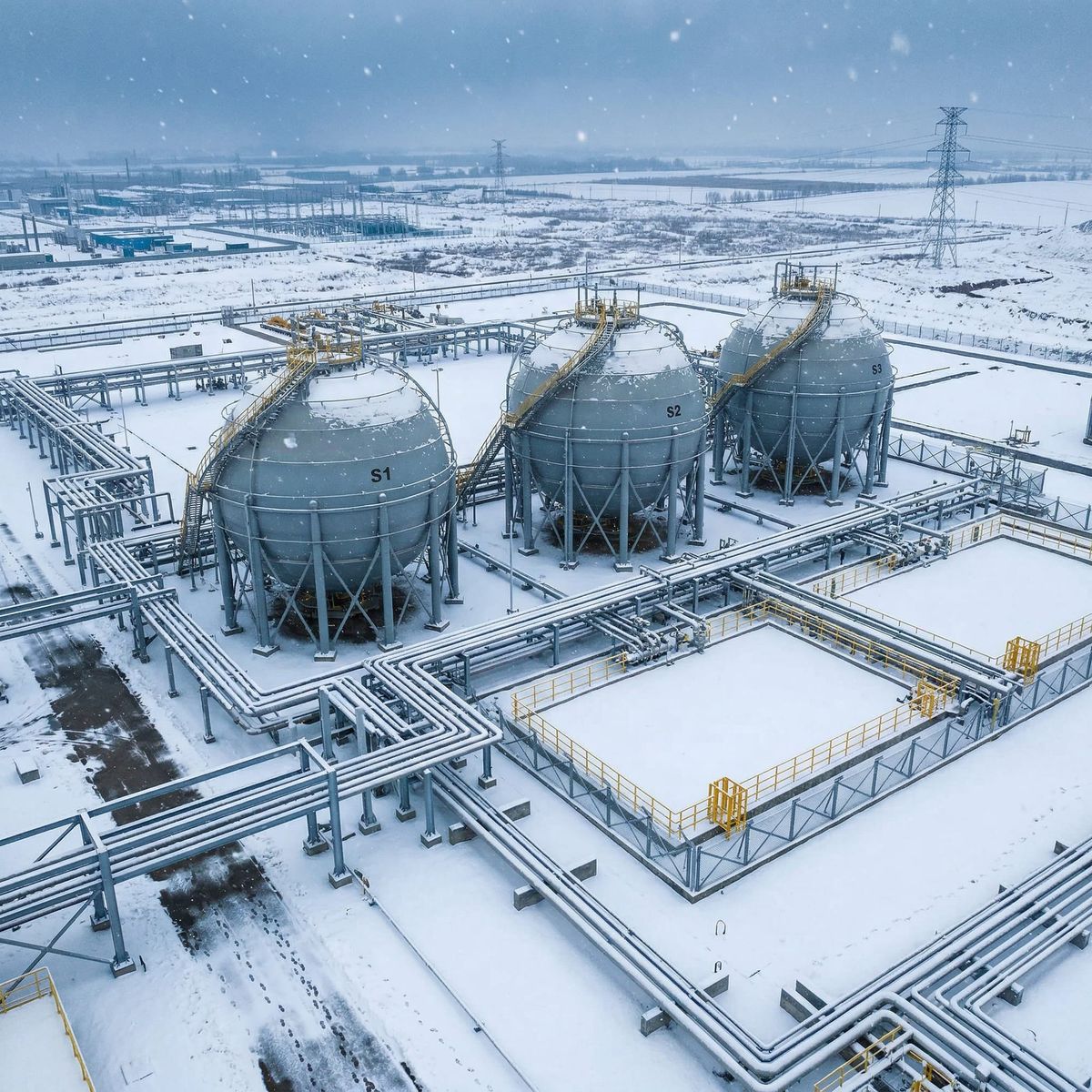
Every fall, the natural gas market focuses intensely on two numbers: working gas storage in underground facilities, and where that number sits relative to the five-year average. Both inform the winter price setup, and both have shifted in ways that matter for the 2025-26 heating season.
As of the EIA's most recent weekly report in mid-November 2025, total working gas in storage stands at approximately 3.65-3.75 trillion cubic feet (Tcf)—the precise figure updates weekly, but the directional read is consistent: inventories are running roughly 3-5% below the five-year average, and about 5-8% below year-ago levels. That's a different posture than either of the past two shoulder seasons, when storage ran at or above the five-year average and the market used that surplus as a price ceiling.
How We Got Here
The storage picture reflects decisions made months ago, primarily around production and LNG exports. The U.S. natural gas market operates on a seasonal supply-demand balance where summer injection season (April through October) builds storage to be drawn down during winter heating season (November through March). The trajectory of the injection season determines how much cushion—or deficit—the market carries into cold weather.
The 2025 injection season was slower than prior years for two reasons. First, production growth was muted. As noted elsewhere, EQT's voluntary curtailments earlier in 2025 when prices touched $2.00/MMBtu, combined with reduced Haynesville drilling activity, meant supply additions were below the pace of prior years. The Lower 48 dry gas production roughly flatlined at 100-102 Bcf/d rather than growing at the 2-4 Bcf/d annual increments of 2022-2024.
Second, LNG export demand was robust throughout the summer. Exports running at 13-14 Bcf/d pulled gas out of the supply pool that in prior years would have supplemented injection. The global LNG market—particularly European buyers rebuilding inventory post-Ukraine and Asian buyers managing supply security—provided consistent demand pull that kept U.S. exports near capacity limits.
The net result: a storage inventory that entered winter tighter than the prior two years, which were notable for their surplus-driven price weakness.
The Regional Picture
EIA tracks storage across five regions, and the regional distribution matters for basis pricing and winter price dynamics. The East region—covering Appalachian production and the densely populated Northeast/Mid-Atlantic demand centers—has tracked closest to the five-year average. That's partly because Appalachian producers have been relatively disciplined and partly because the Northeast has reasonable pipeline connectivity to its storage base in depleted fields across West Virginia, Pennsylvania, and New York.
The South Central region, which includes the massive salt cavern storage complex in Louisiana and Texas that serves as a buffer for both Gulf Coast industrial demand and LNG feedgas, is where the most significant deficit exists. Gulf Coast salt caverns can be drawn down and refilled relatively quickly, but sustained below-average storage in this region creates risk: if LNG demand stays high and a cold snap drives heating demand simultaneously, the market can move toward $5-6/MMBtu spot prices very quickly at the Henry Hub.
The Midwest region—covering storage fields in Michigan, Kansas, Iowa, and Illinois—is broadly in line with seasonal averages, providing reasonable cushion for that region's heating-dominated demand.
What the Strip Is Pricing
The Henry Hub futures curve as of mid-November 2025 shows December 2025 at approximately $3.10-3.30/MMBtu, January and February 2026 around $3.50-4.00 (reflecting peak heating season risk), and the summer 2026 strip settling back toward $3.00-3.20. The curve's backwardation is relatively modest compared to prior high-volatility winters—the market is pricing some weather premium but not a repeat of the $8+ spikes of winter 2022.
That strip pricing implies: weather risk is acknowledged but not fully priced; LNG demand is expected to remain robust; and production growth is not expected to accelerate materially before spring. It's a constructive setup for producers who can sell into the winter strip at $3.50+ levels rather than relying on spot exposure.
The Bull and Bear Cases
Bull case: December and January come in cold. The Northeast and Midwest both need elevated heat. Storage withdrawals run 15-20% above the 10-year average for 6-8 weeks. Henry Hub spikes above $5.00 in January. This would be consequential for Appalachian producers—EQT, CNX, Coterra—and catastrophic for gas-intensive industrial consumers who didn't hedge adequately.
Bear case: Winter is warm again—the third consecutive mild heating season. Storage withdrawals undershoot. By March, working gas approaches 2.0+ Tcf (historically when the market starts to see bearish pressure). Production that was curtailed in 2025 returns. Henry Hub drifts back toward $2.50 by Q2 2026. The structural bull thesis gets repriced again.
Base case: A normal winter draws storage to approximately 1.3-1.5 Tcf by end of March. That's a manageable level that supports $3.00-3.50 Henry Hub through Q1 and allows a measured refill season. Producers get meaningful cash flow improvement over 2024, but the market doesn't generate the volatility that makes headlines.
Operator Implications
Gas-weighted producers who hedged conservatively going into 2025—locking in floors at $2.50 or below—have limited upside exposure to a price recovery. EQT entered 2025 with a hedging book that provided protection but capped some upside, a tradeoff the company acknowledged explicitly. The lesson for 2026: if the structural bull case is valid, producers should hedge for downside protection but keep meaningful upside exposure.
The storage setup entering winter 2025-26 doesn't guarantee a price recovery, but it provides a foundation that the prior two years lacked. That's worth something—exactly how much depends on whether cold air masses agree with the fundamentals.
Crude Intelligence Report is an independent upstream oil and gas intelligence publication. Content is for informational purposes only and does not constitute investment advice, financial advice, or a recommendation to buy or sell any security. Always conduct your own due diligence before making investment decisions. The author and publisher hold no positions in any companies mentioned in this article. © 2026 Crude Intelligence Report. All rights reserved.