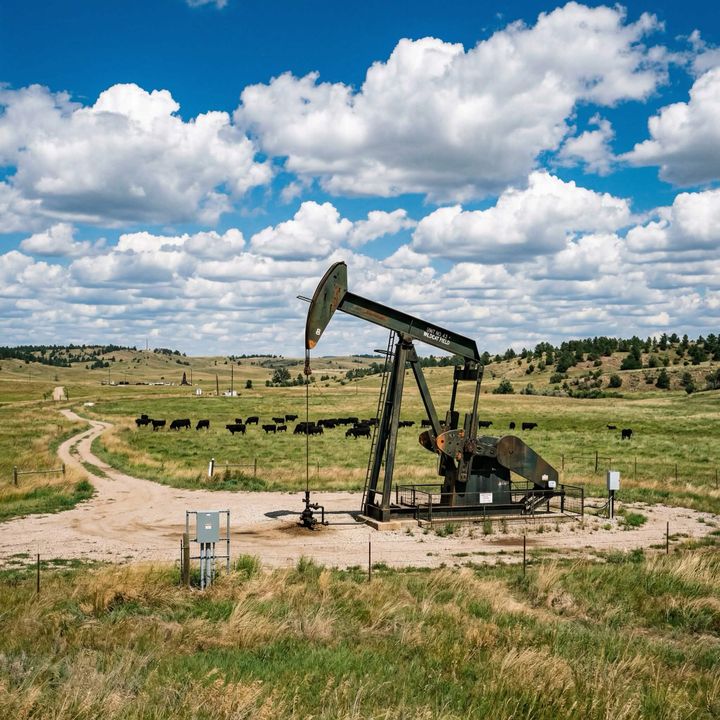
Devon-Coterra: The $58 Billion Bet on Delaware Basin Dominance
Devon Energy and Coterra Energy are creating a $58 billion shale giant through an all-stock merger. CIR breaks down the Delaware Basin math, the synergy targets, and what it means for competitors and vendors.

The strategic logic is straightforward. Both companies entered 2026 with heavy Delaware Basin exposure and limited high-quality drilling inventory relative to their capital bases. Combining creates the largest Delaware Basin drilling inventory in the industry, with sub-$40 per barrel breakevens on the best acreage. At a stroke, the new Devon eliminates redundant G&A, consolidates service contracts, and adds Coterra's Marcellus gas optionality to Devon's liquids-weighted production base.
The transaction requires DOJ approval, Devon shareholder approval, and Coterra shareholder approval. Closing is targeted for Q2 2026. The combined company expects $1 billion in annual pre-tax synergies within two years of close.
CIR's read: this is a Delaware Basin land grab dressed in financial engineering language. Strip away the synergy targets and what you have is two operators who recognized that neither could drill their way to best-in-class efficiency alone. Together, they can.
The Combined Entity: By the Numbers
Pro-forma production based on Q3 2025 actuals: exceeding 1.6 million barrels of oil equivalent per day (MMboe/d), including over 550,000 barrels of oil per day and 4.3 billion cubic feet of natural gas per day. That makes the combined company one of the top three independent E&Ps in the United States by production volume, behind only ExxonMobil's Permian operations and ConocoPhillips.
Acreage footprint:
- Delaware Basin (Permian): Largest drilling inventory in the basin, sub-$40/bbl breakeven on tier-1 locations
- Anadarko Basin (Oklahoma/Kansas): Combined position creating dominant multi-basin operator in the Midcontinent
- Eagle Ford (South Texas): Devon's mature but cash-generating position
- Marcellus Shale (Appalachia): Coterra's gas-heavy position providing natural gas optionality into LNG export markets
- Powder River Basin (Wyoming): Devon's smaller Rockies position
Financial profile (pro-forma, estimated):
- Combined enterprise value: ~$58 billion
- Devon standalone market cap (March 2026): ~$33B (DVN at $52.44/share, ~630M shares)
- Coterra standalone market cap (March 2026): ~$29B (CTRA at $36.60/share, ~794M shares)
- Combined debt: estimated $8-10 billion post-transaction
- Target synergies: $1 billion annual pre-tax, with LOE, G&A, and completion efficiencies as primary drivers
- Post-merger dividend payout: targeted at approximately 15% of operating cash flow
Production breakdown (estimated pro-forma): Oil approximately 34% of total volumes, NGLs 18%, natural gas 48%. The gas weighting is higher than pure-play Permian operators like Diamondback — a deliberate diversification play that adds value when Henry Hub is above $3.50/Mcf and creates risk when it is not.
Delaware Basin: Why Now?
Why now? Three reasons.
First, inventory scarcity. The Delaware has been intensively drilled for a decade. The best multi-zone stacking targets in Eddy and Lea Counties, New Mexico — the northern Delaware where Coterra is heaviest — are becoming harder to add via acquisition. The remaining undeveloped locations concentrated in private hands command premiums that neither Devon nor Coterra could justify individually. Together, they have enough scale to be their own inventory factory through operational optimization.
Second, service cost leverage. With over 1.6 MMboe/d of combined production and a Delaware-focused capital budget estimated at $3.5-4 billion annually, the combined company has bargaining power with pressure pumpers, sand suppliers, and drilling contractors that neither company wielded independently. In a tight-market environment, that translates directly to lower completion costs per lateral foot.
Third, infrastructure rationalization. Devon and Coterra operated overlapping saltwater disposal systems, midstream agreements, and water recycling networks across the Delaware. Combining eliminates duplicate fixed costs and allows a consolidated water management infrastructure — critical in a basin where produced water volumes can reach 8-10 barrels per barrel of oil. The water angle alone may account for $150-200 million of the $1 billion synergy target.
What it means for basin dynamics: the merged Devon becomes the largest single Delaware Basin operator by drilling activity. That concentrates purchasing power with service companies, compresses the market for available tier-1 acreage, and sets new benchmarks for well productivity and cost efficiency that smaller operators must match or accept competitive disadvantage.
What Devon Brings
Devon enters this merger as a liquids-weighted, multi-basin E&P that has spent the last four years simplifying its portfolio after the WPX merger in 2021. Devon's Q3 2025 standalone production was approximately 830,000 Boe/d, with the Delaware Basin accounting for roughly 40-45% of total volumes.
Core assets:
- Delaware Basin (Permian, NM/TX): Devon's crown jewel. Approximately 400,000 net acres across the Bone Spring and Wolfcamp formations. Multi-zone stacking, water recycling infrastructure already in place, sub-$30 breakevens on best locations.
- Eagle Ford (South Texas): Mature, high-margin oil window production. Approximately 100,000-120,000 Boe/d. Strong cash generation, limited growth capital requirement. This asset funds Delaware growth.
- Anadarko Basin (Oklahoma): Devon's legacy Midcontinent position. Oil, NGL, and gas production from the STACK and SCOOP plays. About 100,000 Boe/d. Valuable for its Midcontinent scale when combined with Coterra's Oklahoma presence.
- Powder River Basin: Smaller Rockies position producing approximately 30,000-35,000 Boe/d. Likely a candidate for optimization or divestiture post-merger.
Devon's financial profile heading into the merger: strong balance sheet with net debt around $5-6 billion, a fixed-plus-variable dividend framework that has consistently returned 50-70% of free cash flow to shareholders, and an LOE structure (roughly $10.50-11.00/Boe) that has been improving annually through operational scale.
Devon also brings the management team. CEO Rick Muncrief will lead the combined company. Devon's operational execution in the Delaware — particularly its multi-zone development program and recycled water utilization rates — are industry-leading benchmarks.
What Coterra Brings
Coterra Energy was formed in 2021 through the merger of Cabot Oil & Gas and Cimarex Energy. It is inherently a diversified operator: Permian oil, Marcellus gas, Anadarko midcontinent. That diversification has been both its strength and its perennial discount to pure-play comps.
Core assets:
- Delaware Basin (Permian): Coterra's Permian position in Eddy and Lea Counties, New Mexico — the northern Delaware — is arguably the highest-quality rock Coterra owns. Pro-forma, this acreage merges seamlessly with Devon's southern Delaware position to create a contiguous development corridor.
- Marcellus Shale (Pennsylvania/West Virginia): Coterra produces approximately 2.5-2.8 Bcf/d from the Marcellus. This is the asset that changes the combined company's gas exposure profile. With LNG export capacity expanding dramatically through 2026-2028, Coterra's Marcellus position is a strategic optionality play. At $3.50+ Henry Hub, it generates substantial free cash. At $2.00 Henry Hub, it is a drag.
- Anadarko Basin: Coterra's Oklahoma position in the STACK/SCOOP plays. Combined with Devon's Anadarko assets, the merged company will be the dominant Midcontinent independent.
Synergy Math: Is $1 Billion Realistic?
The $1 billion annual pre-tax synergy target breaks down across four primary categories. Here is CIR's assessment of what is achievable and what requires execution discipline.
G&A reduction: $200-250 million
Two public company structures collapsing into one. Duplicate corporate functions, investor relations teams, legal/compliance, executive compensation. This is the most reliable synergy bucket. Devon and Coterra combined employ roughly 5,000-6,000 people. Even a 5-8% workforce reduction through attrition and consolidation generates $150-200 million in annual savings. The remainder comes from eliminating duplicate public company overhead. Call it $200-250 million with high confidence.
LOE and operating efficiency: $300-350 million
Operating lease equipment, produced water disposal contracts, chemical purchasing, and wellsite monitoring. In overlapping acreage areas, Devon and Coterra are paying for duplicate saltwater disposal networks and separate chemical supply agreements. Consolidating these into single-vendor contracts across a larger volume base should generate $250-350 million annually. The Delaware water infrastructure overlap is key — if the combined company can rationalize two competing SWD networks, operating costs per barrel of water decline materially.
Completion efficiencies: $250-300 million
Combined completion volume across the Delaware Basin puts the new Devon in a different tier of pricing power with pressure pumpers. At 1.6 MMboe/d of production and ~$3.5-4B in combined Delaware capex annually, they are the largest single buyer in the basin. Frac fleet commitments at scale, dedicated sand supply agreements, and shared logistics for tubulars and wellsite equipment — conservative estimate is $250-300 million in annual completion cost savings versus running the two programs independently.
Infrastructure and midstream: $100-150 million
Overlapping gathering agreements, duplicate compression facilities, redundant pipeline takeaway contracts. The Delaware Basin infrastructure rationalization is the most speculative bucket — it depends on contract terms, counterparty flexibility, and timing. Lower confidence, but $100-150 million is achievable over 3-5 years.
CIR verdict on synergies: $1 billion is achievable and probably conservative on a three-year horizon. The G&A and LOE buckets alone likely hit $500-600 million within 18 months of close. The completion efficiency gains and infrastructure rationalization add the rest over years two and three. The risk is integration distraction slowing Delaware drilling momentum during the transition period — that costs more than any synergy saves if it lasts more than two quarters.
What Competitors Should Know
The merged Devon becomes a structural buyer of Delaware Basin services at scale. That is deflationary for oilfield service pricing if it comes with commitment — and inflationary for acreage valuations near their combined position.
For Diamondback, Pioneer/ExxonMobil, and ConocoPhillips, the new Devon is not an existential threat but it is a new competitive benchmark. Diamondback has been the Delaware efficiency standard; Devon-Coterra will challenge that claim with combined operational data sets and larger-scale development programs.
For mid-cap Delaware operators — Permian Resources, Civitas, Matador — the new Devon's purchasing power in service markets creates cost pressure. They will either negotiate harder for their own volume commitments or accept a widening cost disadvantage. The M&A implication: the window for mid-caps to find merger partners at reasonable multiples is narrowing as the consolidation cycle progresses.
Acreage near the Devon-Coterra combined footprint, particularly in northern Eddy County, NM, will trade at a premium. Any remaining private operators in that corridor have just seen their exit multiples improve.
What Vendors Should Know
Combined Delaware Basin capex of $3.5-4 billion annually makes Devon-Coterra the largest single buyer of completion services in the basin. Pressure pumpers with long-term contracts will want renegotiation. Those without will want in.
The combined procurement function will consolidate chemical purchasing, tubulars, artificial lift equipment, and wellsite rentals. Vendors who currently sell to both Devon and Coterra separately should expect a consolidation review within 6-12 months of close. Volume commitments will increase but unit pricing will decrease. That's the trade.
Water management vendors are the most directly exposed. Devon and Coterra both run significant produced water recycling and disposal programs in the Delaware. The merged company will evaluate every SWD well, recycling facility, and transport contract. Redundant infrastructure gets eliminated. Surviving vendors get larger volume commitments but must price competitively. The net effect for water midstream is: lower margin per barrel, higher certainty of volume.
Drilling contractors should expect a fleet rationalization review. The combined company's Delaware development program will be rationalized into a smaller number of dedicated rigs at lower day rates, with longer-term commitments. Contractors who can deliver 24,000+ foot extended-reach laterals with sub-14-day spud-to-TD cycles are positioned to win. Those who cannot are at risk of losing dedicated contracts.
Risks
DOJ antitrust: The DOJ review is underway. The agency's challenge is definitional — what constitutes the relevant market? If DOJ defines it as the Delaware Basin specifically, the combined company's market share is large. If defined as U.S. independent E&P broadly, the combined company is a fraction of total production. Forbes reported in late February that the DOJ is struggling with this precise definitional question. CIR's view: the deal clears but potentially with minor acreage divestitures in overlapping areas. Probability of block: low (<10%).
Integration execution: The Devon-WPX integration (2021) was executed cleanly. The Devon-Coterra integration is larger, spans more basins, and involves a gas-heavy asset (Marcellus) that Devon has not previously operated. Personnel retention in Coterra's Appalachia team is a genuine risk. If key reservoir engineers and development planners exit, Marcellus well productivity could deteriorate during the transition.
Commodity price: The synergy math assumes Delaware production continues at $60+ WTI economics. Currently WTI is elevated (~$98/bbl due to US-Iran conflict premium). If that premium evaporates and WTI returns to $65-70, the deal still works on synergies alone. At $55 WTI sustained, the combined debt load becomes a constraint on capital allocation flexibility. The Marcellus adds a natural gas hedge but also adds exposure to Henry Hub. Two commodity risks, not one.
Shareholder approval: Devon shareholders are essentially buying Coterra's diversification discount. Some will not want it. Activist pressure to divest the Marcellus post-close is a real possibility if gas prices disappoint.
CIR Verdict
This deal makes strategic sense. The Delaware Basin consolidation logic is sound, the synergy targets are credible, and the combined management team has the execution track record to deliver.
The Marcellus gas position is the wildcard. It either becomes a differentiating asset as LNG export demand grows or it becomes a distraction that dilutes the Delaware Basin narrative. CIR's view is that Coterra's Marcellus is undervalued at current gas prices and that the combined Devon has the balance sheet to hold it through the cycle.
Watch three things: DOJ outcome, Q1 2026 production guidance from both companies pre-close, and the first combined capex budget. How Devon-Coterra allocates capital across the Delaware, Marcellus, Eagle Ford, and Anadarko will tell you everything about what this company actually believes in its own portfolio. The Delaware should get 55-60% of E&P capex. If it does not, the strategic rationale starts to fray.
Crude Intelligence Report is an independent upstream oil and gas intelligence publication. Content is for informational purposes only and does not constitute investment advice, financial advice, or a recommendation to buy or sell any security. Always conduct your own due diligence before making investment decisions. The author and publisher hold no positions in any companies mentioned in this article. © 2026 Crude Intelligence Report. All rights reserved.