CIR Morning Brief — Monday, April 6, 2026

A potential ceasefire deal sits on tables in both Washington and Tehran this morning — and how they respond could define the next 30 days in crude markets. According to Reuters, Pakistan has transmitted a ceasefire framework to both the United States and Iran that, if accepted, would reopen the Strait of Hormuz. The proposal is reportedly the most structured diplomatic initiative since the conflict began in late March, and it gives traders a concrete catalyst to watch this week.
That single headline is the setup for everything else unfolding across global energy markets. WTI is holding above $110/bbl after briefly trading at $111.20 Sunday night — a rare premium over Brent. The market is not pricing in a quick resolution, but it is clearly watching for one. Any credible progress toward reopening Hormuz would trigger a sharp reversal. Any breakdown accelerates the path JP Morgan outlined last week: $150/bbl if the strait remains closed through mid-May.
What CIR Is Watching This Week
1. Pakistan-Mediated Ceasefire Talks. This is the dominant story. The key question: does either party engage seriously? Iran's position has hardened following the Bahrain drone strike and UAE Habshan facility disruption. Trump's weekend language was unusually threatening. But Pakistan's credibility with both sides is real. Watch for any White House or Iranian foreign ministry statement this week.
2. OPEC's "Paper Barrels" Problem. OPEC agreed Sunday to a nominal +206,000 bbl/day production increase — but it's theoretical. According to OilPrice.com, OPEC's combined output losses in March hit approximately 7.2 million bbl/day, per LSEG and Kpler data. Kuwait, Iraq, UAE, and Saudi Arabia are still the deepest cut. These barrels can't move until Hormuz opens. The increase is a signal to markets, not physical supply.
3. Qatar LNG Tanker Fleet Paralysis. Nearly 50 Qatar LNG carriers are sitting idle across Asia, according to Bloomberg. That's roughly one-quarter of Qatar's entire export fleet stuck at anchor. Asia-Pacific buyers are scrambling for alternatives, and U.S. LNG export capacity — already running near max — is the most logical alternative supply source. Watch Haynesville production data this week for any response.
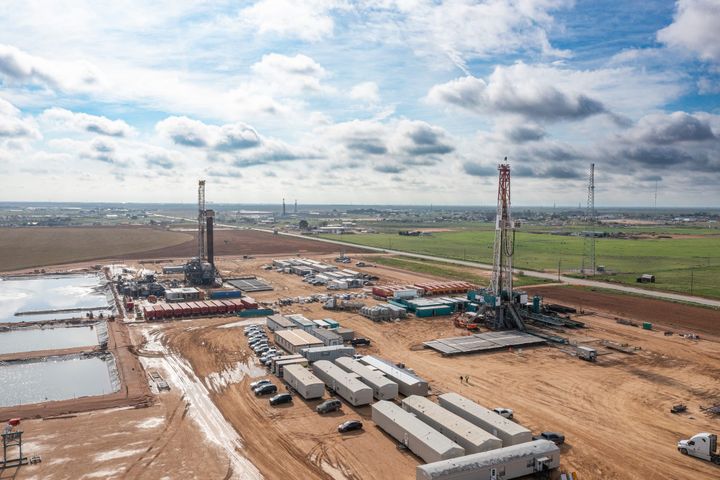
4. U.S. Rig Count Baseline. Baker Hughes released the April 2 North America rig count Friday. Domestic land drilling remains the backstop story: U.S. producers cannot quickly accelerate beyond current pace, but operators positioned in the Permian and Haynesville are benefiting most from price strength. CIR will have the basin breakdown in tomorrow's update.
Market Pulse
WTI crude is trading at approximately $110.15/bbl this morning (down ~$1.39 from Friday's close), still holding an unusual premium over Brent, which is at $108.14/bbl. The spread reflects market confidence in U.S. Gulf Coast crude quality and pipeline access. According to OilPrice.com, Henry Hub front-month futures are at $2.86/MMBtu, up 2.1% — likely tracking global LNG dislocation concerns.
CIR Analysis: The ceasefire mediation is real news, but the gap between a proposal and an accepted deal remains enormous. For U.S. upstream operators, the current price environment is generating free cash flow windfalls that would be the envy of any cycle. The question now is whether boards stick to discipline or begin accelerating activity.
📊 CIR Analysis: Q1 2026 Earnings Preview: Which U.S. E&Ps Are Positioned for Windfall Cash Flows — and What Will They Do With Them?
CIR is independent O&G intelligence for informational purposes only. Not investment advice. No positions held. © 2026 CIR.