
Appalachia Gas: The Recovery Trade
Appalachian gas producers endured two years of suppressed prices and deliberate production cuts. With Henry Hub recovering, the question is whether they benefit or whether the recovery pulls in competing supply.
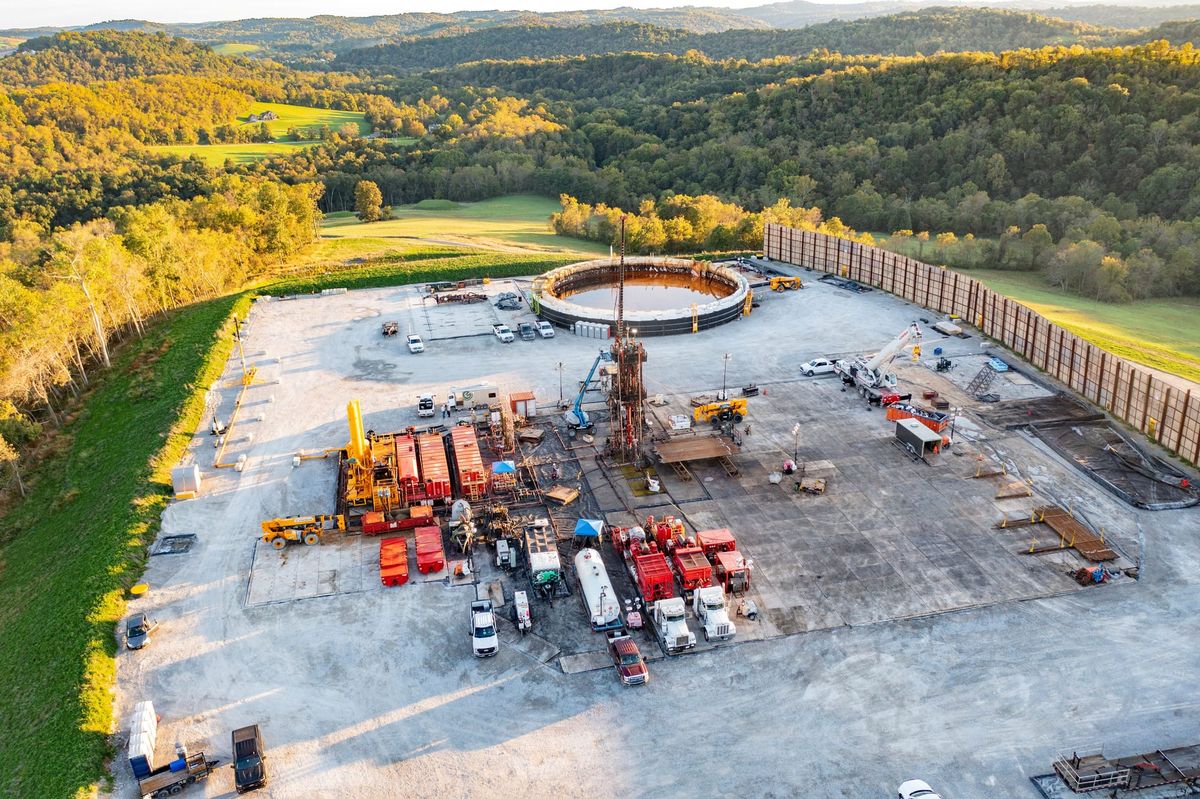
No basin in U.S. upstream has had a harder two years than Appalachia. The Marcellus and Utica shales—which together account for roughly 35-37 Bcf/d of dry gas production, nearly a third of U.S. natural gas output—have been caught in a painful combination of weak prices, regional basis blowouts, and a market that seemed structurally indifferent to their operating economics.
EQT Corporation, the largest U.S. natural gas producer, made voluntary production curtailments a feature rather than a bug of its 2025 strategy—explicitly telling investors that it would withhold supply from a market that didn't value it. Range Resources ran at reduced activity. CNX Resources focused on balance sheet over growth. Coterra Energy shifted capital toward its Permian oil business and let its Marcellus program idle.
With Henry Hub now recovering toward $3.00/MMBtu and the structural case for higher prices building, the Appalachian trade looks increasingly interesting. But the recovery is not without complications.
The Basin's Fundamental Economics
Appalachian gas is, at its core, extraordinarily cheap to produce. The Marcellus Shale—particularly the core "dry gas" window in northeastern Pennsylvania and West Virginia—generates wellhead economics that rival any basin in North America. EQT's capital efficiency numbers tell the story: $0.60-0.70 per Mcfe all-in breakeven on its best acreage, with laterals extending to 15,000-17,000 feet in Greene County, Pennsylvania. Range Resources works the southwest "wet gas" Marcellus window around Washington County, where NGLs provide a meaningful production value uplift.
The problem has never been production cost—it's been getting gas to market at adequate prices. The Northeast pipeline system is the tightest in the country relative to supply capacity. The failure of the Constitution Pipeline, the prolonged battle over Mountain Valley Pipeline (finally completed in 2024), and persistent FERC permitting delays have left the basin chronically short on takeaway capacity, particularly northward into New England and southward toward Gulf Coast LNG markets.
The result: when the regional market is oversupplied even modestly, Appalachian basis collapses. Dominion South—the benchmark Appalachian pricing point—has traded at discounts of $0.50-2.00/MMBtu to Henry Hub during stress periods. At $2.00 Henry Hub with a $1.00 basis discount, Appalachian producers net $1.00/Mcf on their gas—a number that covers little beyond lifting costs on even the best acreage.
Mountain Valley Pipeline: The Capacity Release
The most significant infrastructure development for Appalachia in 2025 was not a new pipeline announcement—it was the startup of Mountain Valley Pipeline, completed in mid-2024 after a decade of legal and regulatory battles. MVP adds 2.0 Bcf/d of takeaway capacity moving Appalachian gas south to Transcontinental Gas Pipeline's main line and ultimately into Southeast and Gulf Coast markets.
The addition of that capacity has structurally improved Appalachian basis. Dominion South has traded at notably tighter discounts to Henry Hub since MVP startup than it did in the 2022-24 period. The degree to which basis tightens further depends on utilization rates and whether the additional supply that MVP enables gets drilled—but the directional improvement is real and measurable.
EQT: The Bellwether
No company matters more to the Appalachian story than EQT Corporation. With roughly 6.0 Bcf/d of net production capacity and the largest proved reserve base of any U.S. gas producer, EQT's capital allocation decisions effectively set the supply side of the Appalachian market.
CEO Toby Rice has been consistent in his messaging: EQT will not produce gas that can't find a home at economic prices. The curtailment strategy implemented in Q1-Q2 2025, when prices touched $2.00/MMBtu, was unusual in the industry—gas producers historically maintain production through downturns to preserve cash flow and field infrastructure. EQT's willingness to curtail reflects both confidence in its low-cost structure and a calculated bet that restraint would support prices.
At $3.00+ Henry Hub, EQT's free cash flow picture improves dramatically. The company operates at roughly $2.0-2.5 billion of annual capex. At $2.50 NYMEX, it generates modest FCF that primarily supports the dividend and debt service. At $3.50, FCF approaches $1.5-2.0 billion—enough for meaningful buybacks, debt reduction, or both. The stock's sensitivity to gas prices is substantial: roughly $0.10/MMBtu in Henry Hub pricing translates to approximately $200-250 million in annual EBITDA at EQT's production scale.
The LNG Demand Pull
The longer-term catalyst for Appalachian producers is LNG export demand routed through Gulf Coast facilities. The missing link is additional pipeline capacity connecting Appalachian supply to Gulf Coast LNG terminals. Projects like the proposed Atlantic Coast Pipeline (cancelled) and Equitrans' other proposed routes have faced consistent permitting opposition.
The Mountain Valley Pipeline extension (MVP Southgate) into North Carolina and the proposed Commonwealth LNG project's contractual connection to Appalachian supply are the next pieces. If those projects advance—and the political environment post-election is modestly more favorable to permit approvals—Appalachian gas finds a dedicated demand market that insulates it from regional oversupply dynamics.
Until those connections are built, Appalachian producers are partly dependent on weather-driven demand in the Northeast and Mid-Atlantic markets, and partly on the industrial demand in the Mid-Atlantic corridor. It's adequate in a cold winter, constrained in a warm one.
The Recovery Trade: Who to Watch
EQT is the most direct expression of the Appalachian recovery trade—it's the largest, lowest-cost, most operationally efficient producer in the basin. CNX Resources offers a different angle: it's smaller, has a large coal bed methane legacy business, and trades at a meaningful discount to EQT on reserve-replacement metrics. Range Resources is the Marcellus wet gas play—its NGLs provide some commodity diversification but also link its performance to ethane and propane pricing alongside gas.
Coterra Energy is the hybrid—Marcellus gas plus Permian oil—and its management has been explicit that capital follows the best returns. At $3.00+ Henry Hub, the Marcellus becomes more competitive internally, and Coterra's Appalachian rig count likely increases in 2026 planning.
Appalachia's recovery is the most leveraged, highest-torque trade in natural gas if the structural bull case plays out. It's also the most punishing if another warm winter proves the fundamental thesis wrong again. Position sizing accordingly.
Crude Intelligence Report is an independent upstream oil and gas intelligence publication. Content is for informational purposes only and does not constitute investment advice, financial advice, or a recommendation to buy or sell any security. Always conduct your own due diligence before making investment decisions. The author and publisher hold no positions in any companies mentioned in this article. © 2026 Crude Intelligence Report. All rights reserved.